Physical Address
304 North Cardinal St.
Dorchester Center, MA 02124
Physical Address
304 North Cardinal St.
Dorchester Center, MA 02124

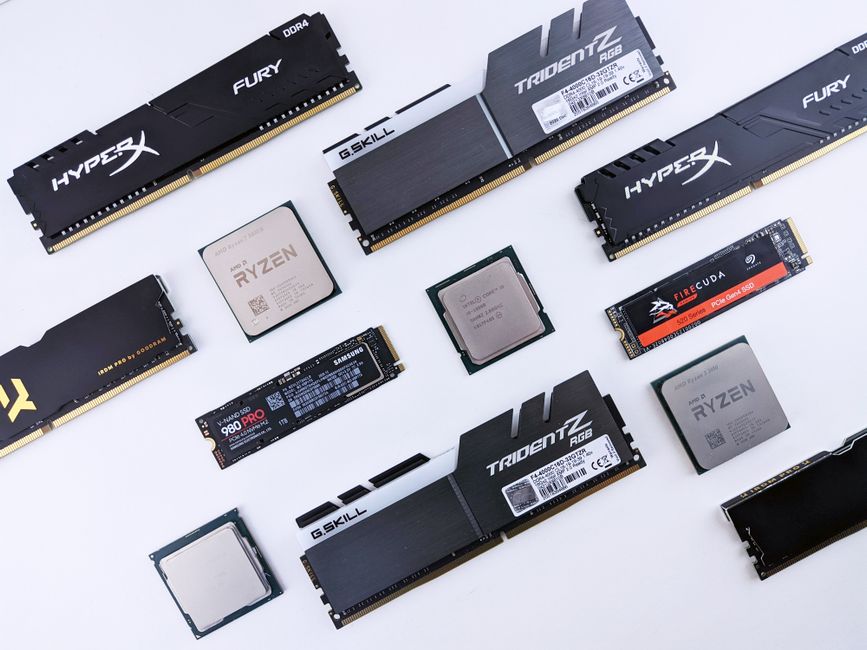
Comparing the Samsung 9100 Pro vs Crucial T705 in 2026. Find out which PCIe 5.0 SSD offers the best speed, thermals, and value amid the AI storage crunch.
The consumer storage landscape has shifted dramatically, culminating in a highly competitive, yet volatile, solid-state drive (SSD) market in 2026. High-performance desktop computing, enthusiast gaming, and intensive client-side artificial intelligence (AI) workloads have placed unprecedented demands on local storage. Users no longer settle for standard boot times; they require blazing throughput capable of handling complex data-modeling applications, rapid texture streaming via Microsoft DirectStorage, and local machine-learning processes. This has turned PCIe Gen 5.0 NVMe SSDs from an expensive luxury into the gold standard for high-end builds.
However, navigating the storage market in 2026 is uniquely challenging. A severe “AI storage crunch” has emerged, driven by flash manufacturers shifting their production lines toward high-margin enterprise AI infrastructure. This NAND shortage has inflated consumer prices and restricted the availability of flagship drives. Two of the most prominent contenders in this high-stakes arena are the Samsung 9100 Pro and the Crucial T705. While both promise elite Gen 5 performance, they represent fundamentally different hardware philosophies and lifecycle stages. This comprehensive comparison details how these two titans stack up in speed, efficiency, thermals, and overall value in 2026.
Before diving into the detailed architectural differences, let’s look at the baseline technical specifications and real-world 2026 pricing for both the Samsung 9100 Pro and the Crucial T705.
| Feature | Samsung 9100 Pro | Crucial T705 |
|---|---|---|
| Released | February 2025 | February 2024 |
| Interface / Protocol | PCIe Gen 5 x4 / NVMe 2.0 | PCIe Gen 5 x4 / NVMe 2.0 |
| Controller Node | Samsung “Presto” (5nm FinFET) | Phison PS5026-E26 (12nm TSMC) |
| NAND Flash Type | Samsung V-NAND V8 TLC (236-layer) | Micron 232-layer TLC NAND |
| Max Sequential Read | Up to 14,800 MB/s | Up to 14,500 MB/s |
| Max Sequential Write | Up to 13,400 MB/s | Up to 12,700 MB/s |
| Max Random Read/Write | Up to 2,200K / 2,600K IOPS | Up to 1,500K / 1,800K IOPS |
| Max Capacity Option | 8TB | 4TB |
| Max Peak Power Draw | ~8.1 Watts | ~11.5 Watts |
| Warranty / Endurance | 5-Year / 600 TBW per Terabyte | 5-Year / 600 TBW per Terabyte |
| 2026 2TB Pricing | ~$303 (On Sale) to $399 (MSRP) | ~$373 to $398 (Patchy Stock) |
Samsung’s entry into the enthusiast Gen 5 market with the 9100 Pro represents a major technical milestone. Launched in early 2025, the drive moved away from third-party hardware, relying on Samsung’s proprietary “Presto” (S4LY027) controller. Manufactured on a cutting-edge 5nm process, this 5-core ARM-based chip is a marvel of energy efficiency. Samsung achieved a massive 49% improvement in power efficiency compared to older controllers, drawing roughly 8.1W during active reads and 7.9W during writes.
This efficiency is paired with Samsung’s own 236-layer V-NAND V8 TLC memory chips, allowing the 9100 Pro to fully saturate the PCIe 5.0 x4 interface. On paper, it reaches sequential read speeds of up to 14,800 MB/s and sequential writes of 13,400 MB/s, representing a true 2x leap over the previous-generation 990 Pro. Furthermore, its random performance is staggering, pushing up to 2,200K random read and 2,600K random write IOPS. Beyond raw horsepower, the 9100 Pro’s thermals are its true selling point. It manages these speeds without requiring a skyscraper-sized heatsink, making it exceptionally reliable in compact desktop builds and high-performance laptops.
In terms of pricing in mid-2026, the 9100 Pro has faced fluctuations due to the global NAND flash shortages. While it peaked at nearly $340 for the 1TB and $476 for the 2TB version earlier in the year, recent promotional cycles have brought prices back down. The 2TB sweet-spot model has been spotted on sale for $303 on Amazon, down from its typical $399 MSRP. For enterprise workloads, Samsung also offers an 8TB model, though its price remains steep at around $1,799.
When Micron’s consumer arm launched the Crucial T705 in early 2024, it set world records with sequential reads of up to 14,500 MB/s and writes of 12,700 MB/s. Under the hood, the T705 utilizes Micron’s premium 232-layer TLC NAND paired with the Phison PS5026-E26 controller. The Phison platform is incredibly mature, and multiple firmware revisions have refined its performance, making the T705 an exceptionally reliable workhorse in sustained sequential tasks.
However, the T705 is built on an older 12nm controller node. This aging architecture draws a massive amount of power—up to 11.5W at peak. As a result, the drive generates extreme heat. Without a substantial passive motherboard heatsink or Crucial’s dedicated bulky heatsink, the T705 will quickly run into thermal throttling, dropping its speeds down to Gen 4 levels to protect its silicon. This thermal output completely rules out the T705 for laptop use and makes it difficult to manage in small-form-factor builds.
The biggest story surrounding the Crucial T705 in 2026 is its market availability. In December 2025, Micron officially discontinued its Crucial consumer brand to prioritize the surging demand for high-margin enterprise AI memory and storage. Consequently, the T705 is no longer in active production. Finding a brand-new T705 in 2026 is a matter of locating legacy retail stock. This patchy availability, combined with the wider NAND shortage, has driven retail prices up. The 2TB model currently sits at a volatile $373 to $398, making it a difficult economic proposition compared to actively supported drives.
When deciding between these two elite PCIe 5.0 SSDs in 2026, you should base your purchase on three primary factors: system compatibility, workload intensity, and current market value.
First, consider your system form factor and thermal limits. If you are upgrading a high-end workstation laptop, a mini-PC, or a compact small-form-factor desktop, the choice is clear. The Samsung 9100 Pro is the only viable candidate due to its efficient 5nm controller and lower thermal output. The Crucial T705 is too power-hungry and hot to function safely without a large desktop heatsink. Even in a full-sized desktop, you must ensure your motherboard’s integrated heatsinks are robust enough to tame the T705.
Second, align your choice with your workload. For general gaming, both drives are spectacular, easily supporting Microsoft DirectStorage for near-instantaneous load times. However, if you are a professional content creator, a 3D rendering artist, or someone running local AI models, the Samsung 9100 Pro’s superior random read and write IOPS (2,200K/2,600K vs. the T705’s 1,500K/1,800K) provide a tangible performance edge. Furthermore, the 9100 Pro’s availability in 8TB makes it the premier choice for large local data repositories.
Finally, factor in price, longevity, and support. Because Micron discontinued the Crucial brand at the end of 2025, purchasing a T705 in 2026 carries inherent risk. While it still carries its 5-year limited warranty, locating replacement stock can be difficult, and patchy retail supply has inflated its cost. The Samsung 9100 Pro remains actively supported, frequently discounted, and represents a much safer long-term investment.
Yes, but with caveats. While both drives are backward-compatible with PCIe Gen 4.0 slots, the PlayStation 5 only supports PCIe Gen 4.0 speeds. This means both SSDs will be bottlenecked to roughly 7,000 MB/s, rendering their expensive Gen 5 capabilities useless. Furthermore, the Crucial T705’s massive heat output is a poor match for the PS5’s tight storage bay. For console expansion, you are far better off purchasing a dedicated PCIe 4.0 drive like the Samsung 990 Pro.
In December 2025, Micron decided to sunset its Crucial consumer division. Micron shifted its manufacturing focus entirely to enterprise-class high-bandwidth memory (HBM) and enterprise NVMe SSDs to satisfy the immense demand from AI data centers. As a result, the Crucial T705 is only available as leftover retail stock. This scarcity, paired with a global consumer NAND shortage, has driven its price significantly higher than its original launch MSRP.
The Samsung 9100 Pro is highly efficient thanks to its 5nm “Presto” controller, but it is still a high-performance PCIe 5.0 drive. Under heavy sustained workloads, it does require a heatsink to prevent thermal throttling. Fortunately, most modern PCIe 5.0-compatible motherboards come equipped with high-quality built-in heatsinks. If your motherboard lacks one, you should purchase the 9100 Pro variant that includes Samsung’s built-in heatsink.
The AI storage crunch is a market phenomenon where major memory manufacturers are prioritizing high-margin enterprise AI hardware over consumer-grade NAND. This has led to rising prices and reduced stock for enthusiast-level consumer SSDs. To get the best deal in 2026, buyers must track retail pricing closely, jump on temporary promotional sales, and focus on actively manufactured drives like the Samsung 9100 Pro.
Choosing a winner in 2026 is a straightforward decision. The Crucial T705 was a magnificent pioneer when it launched, showcasing the raw, unbridled throughput possible on the PCIe Gen 5.0 platform. However, in 2026, its aging 12nm Phison controller, high power consumption, and extreme thermal profile make it look dated. Crucially, Micron’s decision to phase out the consumer brand has left the T705 with erratic pricing and shaky long-term availability.
In contrast, the Samsung 9100 Pro is a masterclass in next-generation engineering. Its custom 5nm Presto controller solves the thermal and power-efficiency problems that plagued early Gen 5 drives. Delivering a blisteringly fast 14,800 MB/s read speed, running cooler, offering an incredible 8TB capacity tier, and maintaining active manufacturer support, the Samsung 9100 Pro is the undisputed champion. It is the best Gen 5 SSD to buy in 2026.
Prices and features mentioned are accurate as of the date of publication. Always check the official provider website for the most current pricing and availability.