Physical Address
304 North Cardinal St.
Dorchester Center, MA 02124
Physical Address
304 North Cardinal St.
Dorchester Center, MA 02124

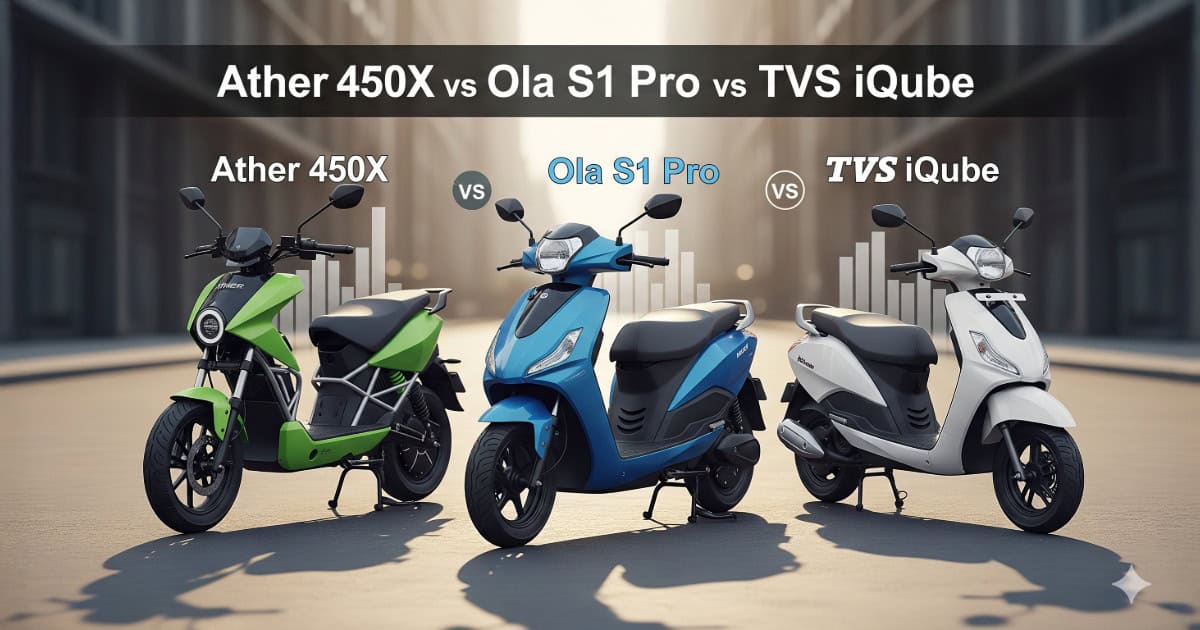
The Ather vs Ola vs TVS iQube comparison has become more critical than ever. The landscape of India’s electric two-wheeler market has been anything but static. For months, it was a battle for dominance between the flashy upstart Ola Electric and the established giant TVS Motor. But in 2025, a significant shift has taken place: Ather Energy has raced ahead of Ola Electric in monthly sales volumes, securing its position as a major contender. This dynamic change, driven in part by a “rare earth supply crunch,” has made the decision for prospective EV buyers more complex and critical than ever.
As experts in product analysis, our goal at ComparisonMath.com is to cut through the noise. We’ll provide a comprehensive, data-driven comparison of the three leading players in the Indian EV scooter segment: the Ather 450X, the Ola S1 Pro Gen 3, and the TVS iQube. By evaluating them on key criteria like performance, technology, and real-world practicality, we’ll help you understand not just which scooter is selling, but why—and, most importantly, which one is right for you.
The recent sales figures tell an important story. For the first 27 days of August, TVS Motor retained its market leadership, but Ather Energy climbed to second place, surpassing Ola Electric for the first time in months. The primary reason for this reordering is a prolonged global shortage of rare earth magnets, which are crucial components in high-performance electric motors.
While TVS and Ather have demonstrated more resilient supply chains, Ola has faced significant production challenges, leading to a dip in its retail sales. This highlights a crucial factor beyond just specs on a sheet: a brand’s operational stability and trustworthiness are now just as important as its product’s top speed. This contextual analysis is central to our verdict.
Our analysis of these three contenders is built on five core pillars, reflecting what truly matters to a rider in a dynamic urban environment.
When it comes to raw power, the Ola S1 Pro Gen 3 holds the numerical advantage. Its 11 kW motor delivers a blistering 0-40 km/h acceleration of 2.7 seconds and a class-leading top speed of 117 km/h. It’s built for riders who want that instant, exhilarating performance. Its certified range is also the highest at 195 km, though user reports suggest a more realistic 150-160 km in mixed-mode city driving.
The Ather 450X, with its 6.4 kW motor, is no slouch. Its 0-40 km/h time of 3.3 seconds is still incredibly quick and its 90 km/h top speed is more than enough for city commutes. What sets Ather apart is the accuracy of its estimated range. The scooter’s on-dash “Distance to Empty” (DTE) is famously reliable, giving riders confidence that their 126 km certified range (which can reach 161 km with the higher-end Stack Pro model) is a realistic figure.
The TVS iQube S takes a more balanced, conservative approach. Its 4.4 kW motor provides a respectable 0-40 km/h in 4.2 seconds and a top speed of 78 km/h. It’s not built for thrills, but it excels at providing a smooth, consistent, and predictable ride. Its certified range of 145 km is also highly reliable in real-world scenarios.
| Metric | Ather 450X (Stack Pro) | Ola S1 Pro Gen 3 | TVS iQube S |
|---|---|---|---|
| Peak Power | 6.4 kW | 11 kW | 4.4 kW |
| Top Speed | 90 km/h | 117 km/h | 78 km/h |
| Certified Range | Up to 161 km | 195 km | 145 km |
| Battery Capacity | 3.7 kWh | 4 kWh | 3.5 kWh |
| Charging Time (0-80%) | 3 hours | 3.5 hours | 4.5 hours |
All three scooters feature modern, touchscreen-based dashboards, but their execution and ecosystem differ.
The Ather 450X has a distinct, futuristic design with a visible aluminum chassis that emphasizes its sporty nature. Its fit-and-finish is widely regarded as the best in the segment, with a premium feel and no rattling panels even after prolonged use.
The Ola S1 Pro has a smooth, minimalist design with a clean aesthetic. It offers a large 34-liter under-seat storage, which is a major practical advantage. However, early reports of panel gaps and less-than-perfect build quality have been a persistent concern, though the Gen 3 model has seen some improvements.
The TVS iQube embraces a classic, family-scooter design. Its look is more conventional and less flashy, which can be a pro for many. TVS’s decades of manufacturing experience are evident in the robust and durable build quality, giving it a reputation for reliability.
Choosing the right scooter from this trio is a matter of aligning your needs with each scooter’s core strengths.
While the certified range is 195 km, most users report a realistic range of 150-160 km under normal city riding conditions, which includes using a mix of Eco, Normal, and Sport modes. Using the high-performance Hyper mode will significantly reduce this range.
The Ather 450X is often priced at a premium compared to its rivals. Its value lies in its superior build quality, polished software experience, and reliable public charging network. For riders who want a premium, worry-free ownership experience, the extra cost is justified.
The TVS iQube S’s certified range is 145 km. Because the scooter is not as performance-focused, its claimed range is very close to its real-world range, making it a highly predictable vehicle for daily commutes and a reliable option for riders.
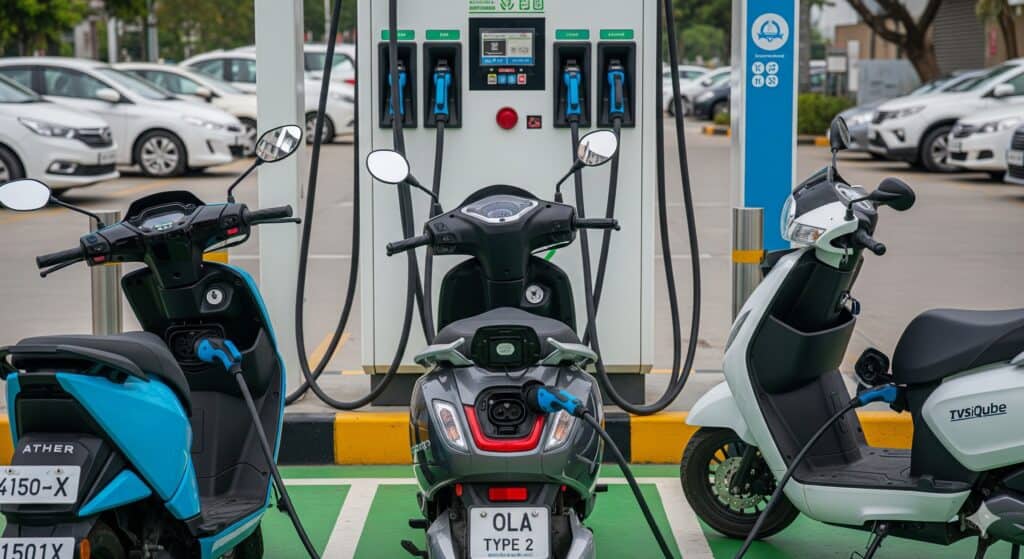
All three scooters can be charged at home using a standard 5A socket. The Ather 450X takes about 4.3 hours for a full charge, the Ola S1 Pro takes about 6.5 hours, and the TVS iQube S takes about 4.5 hours. For faster charging, Ather’s public “Ather Grid” can provide an 80% charge in about 3 hours, while Ola’s Hypercharger network can offer a 50% charge in about 30 minutes.
The TVS iQube benefits from the extensive and well-established service network of TVS Motor, a legacy two-wheeler manufacturer. Ather has also built a strong reputation for customer support and service in urban centers. Ola’s after-sales network is still growing, and while it has a significant presence, its service quality is a more mixed bag, with user reports varying widely.
Prices and features mentioned are accurate as of the date of publication. Always check the official provider website for the most current pricing and availability.