Physical Address
304 North Cardinal St.
Dorchester Center, MA 02124
Physical Address
304 North Cardinal St.
Dorchester Center, MA 02124

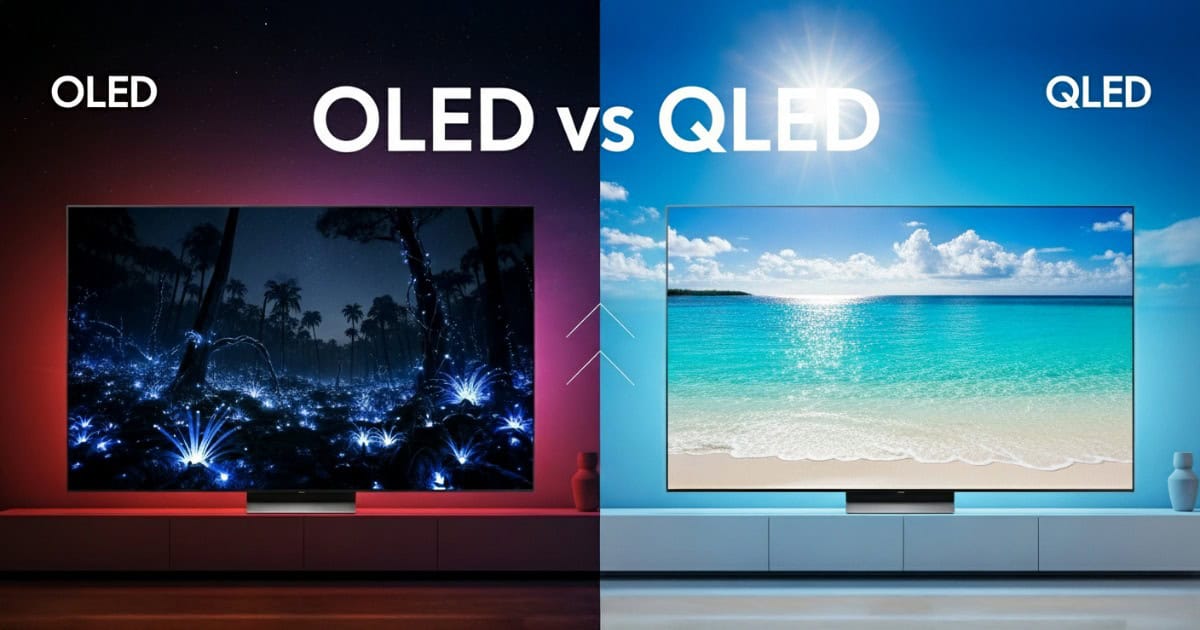
Your interactive guide to choosing the perfect TV. Answer a few questions or dive deep into the data to find out whether OLED’s perfect blacks or QLED’s vibrant brightness is right for you.
Answer 3 quick questions to get a personalized recommendation.
1. What is your primary viewing environment?
2. What is your primary use case?
3. What’s most important to you in picture quality?
QLED’s biggest advantage is its ability to get much brighter, making it ideal for well-lit rooms.
QLED offers better value in budget tiers, while high-end OLEDs deliver peak performance for a premium price.
| Specification | OLED (Typical) | QLED (Typical) |
|---|---|---|
| Contrast Ratio | Infinite:1 (Perfect Black) | 10,000-50,000:1 |
| Response Time | <0.1 ms (Instant) | 2-10 ms |
| Viewing Angles | Excellent (178°) | Good-Very Good |
| Burn-in Risk | Low (manageable) | No risk |
| Peak Brightness | 800-1,200 nits | 1,500-4,000+ nits |
OLED (Organic Light-Emitting Diode) technology is unique because each pixel creates its own light. When a pixel needs to be black, it simply turns off completely. This results in perfect blacks, infinite contrast, and incredibly thin screens because no backlight is needed.
QLED (Quantum Dot Light-Emitting Diode) is an advanced form of LED TV. It uses a powerful LED backlight that shines through a film of tiny “quantum dots.” These dots convert the light into exceptionally pure and vibrant colors, allowing for higher peak brightness and a wider color gamut.
Modern OLEDs have many features to prevent burn-in (pixel shifting, logo dimming), making it rare for normal, varied viewing. It’s only a potential concern if you display the same static image (like a news ticker or game HUD) for many hours every day.
No. Mini-LED is a more advanced backlight technology used in high-end QLED TVs. It uses thousands of smaller LEDs for more precise dimming zones, which improves contrast and reduces the “halo” effect. All Mini-LED TVs are a type of QLED, but not all QLEDs use Mini-LED.
Both are crucial. Response time affects motion clarity (less blur), while input lag is the delay between your controller input and the on-screen action. OLED excels at response time (<0.1ms), eliminating motion blur. Both high-end OLED and QLED offer very low input lag (<10ms) in Game Mode.
Micro-LED is a next-generation technology that combines the best of both worlds. Like OLED, each pixel is self-emissive, providing perfect blacks and infinite contrast. Like QLED, it can achieve extremely high brightness levels, and there is no risk of burn-in. However, Micro-LED TVs are currently prohibitively expensive and typically reserved for very large, modular displays.
For most people, a premium 4K TV is still the better value. While 8K TVs offer incredible pixel density, there is very little native 8K content available, and you need a very large screen size (85 inches or more) and a close viewing distance to even notice the difference in resolution. A high-quality 4K TV with excellent HDR and brightness will provide a more impactful viewing experience for the money.
Prices and features mentioned are accurate as of the date of publication. Always check the official provider website for the most current pricing and availability.




