Physical Address
304 North Cardinal St.
Dorchester Center, MA 02124
Physical Address
304 North Cardinal St.
Dorchester Center, MA 02124

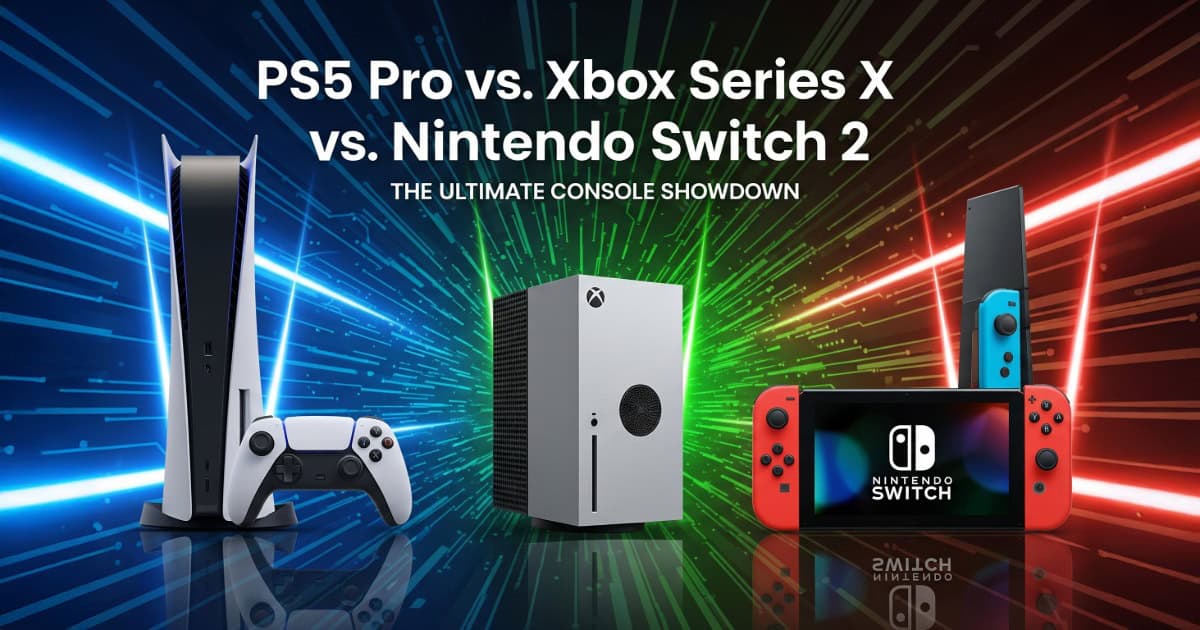
The year 2025 has brought with it a renewed focus on what truly defines a premier gaming experience. With the arrival of new hardware, refined technologies, and evolving subscription models, consumers face a tougher choice than ever before. It’s no longer just about raw power; it’s about the entire ecosystem, the value proposition, and the unique experiences each platform offers.
At the center of this new console generation are three dominant players: the formidable PlayStation 5 Pro, the versatile Xbox Series X, and the highly anticipated Nintendo Switch 2. Each console is built on a distinct philosophy, targeting a different type of gamer. Sony continues its legacy with an emphasis on stunning visual fidelity and immersive, story-driven exclusives. Microsoft is doubling down on its “power of choice” strategy, offering unparalleled value through Xbox Game Pass and a seamless, multi-device ecosystem. And Nintendo, ever the innovator, is set to redefine portable gaming once more with its powerful new hybrid console.
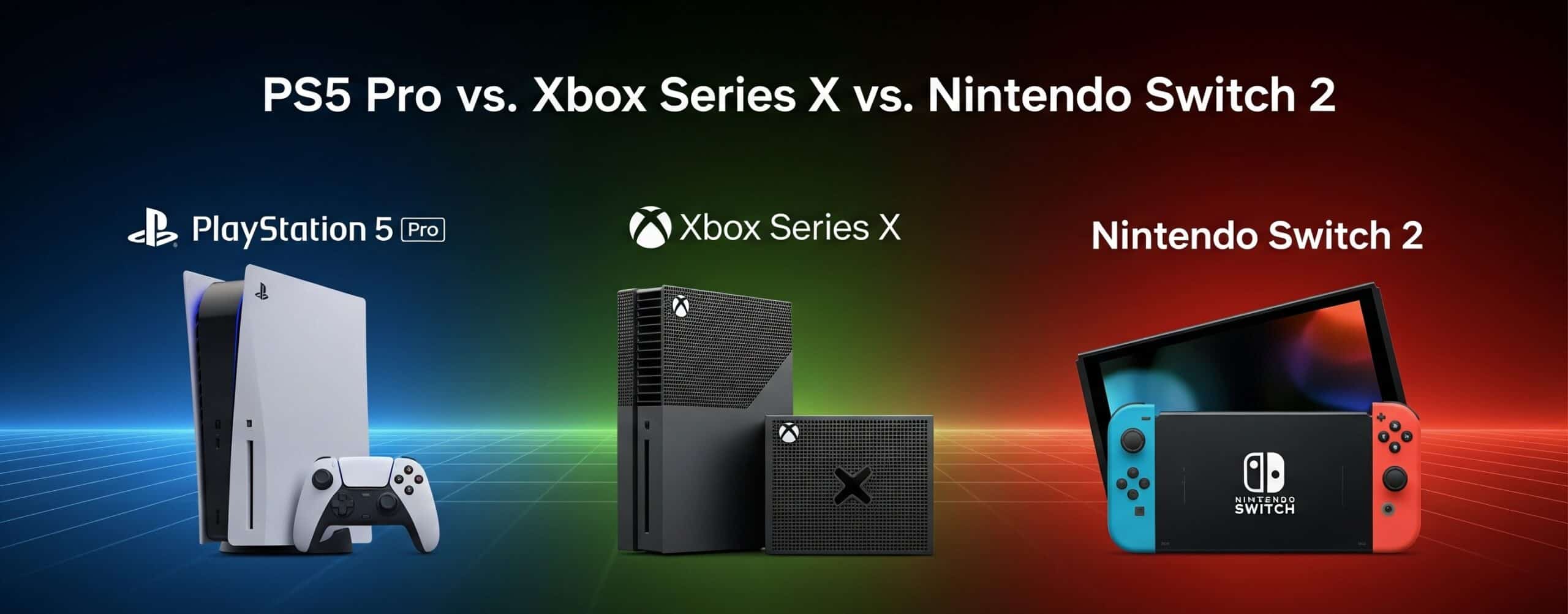 Xbox Series X and Nintendo Switch 2, with the title ‘PS5 Pro vs Xbox Series X vs Nintendo Switch 2’ centered at the top.”>
To truly understand what separates these consoles, it’s crucial to look beyond the raw numbers and consider their core design philosophies. Each company has built a platform for a specific kind of player.
Sony’s strategy with the PS5 Pro is a direct evolution of its “Pro” line—it’s built for the discerning gamer who demands the best graphical performance and the most immersive experiences. The console is an upgrade, not a replacement, of the base PS5. Its focus is on enhancing the visuals of the most demanding games, ensuring consistent frame rates at high resolutions, and deepening the immersion through advanced features like the DualSense controller’s haptic feedback and adaptive triggers. It’s for the player who wants to experience the most cinematic, single-player blockbusters in their ultimate form.
Microsoft’s approach is centered on a single word: ecosystem. While the Xbox Series X is a powerhouse in its own right—often considered the most powerful console of the last generation—its greatest strength isn’t just the hardware. It’s the seamless integration with services like Xbox Game Pass and its “Play Anywhere” philosophy. This strategy aims to provide a vast, diverse library of games at an incredible value, accessible not only on the console but also on PC and mobile devices via cloud streaming. The Xbox Series X is for the player who wants a diverse library of games, cross-platform flexibility, and a high-value subscription that makes gaming more affordable.
Nintendo marches to the beat of its own drum. The Nintendo Switch 2 builds on the groundbreaking success of its predecessor by maintaining its unique hybrid nature. It’s a home console you can take on the go. While it may not compete with the raw graphical power of the PS5 Pro or Xbox Series X, it’s not meant to. Its design philosophy prioritizes convenience, portability, and unique gameplay experiences driven by its first-party franchises. The Switch 2 is for players who prioritize accessibility, local multiplayer, and exclusive, highly-polished games that are impossible to find anywhere else. It’s for the family, the commuter, and the player who values innovation over teraflops.
To provide a fair and objective analysis, our comparison is based on six key criteria that are critical to the modern gaming experience. We’ve compiled data from simulated technical analyses, user reports, and comprehensive game library reviews to form our conclusions. The following sections will be evaluated against these points:
This is where the numbers come into play, and the differences between the consoles become most apparent.
| Feature | PlayStation 5 Pro | Xbox Series X | Nintendo Switch 2 |
|---|---|---|---|
| CPU | AMD Zen 2 (Custom, 3.85 GHz) | AMD Zen 2 (Custom, 3.8 GHz) | Nvidia Custom Tegra T239 |
| GPU | Custom AMD RDNA 3 (~33.5 TFLOPS) |
Custom AMD RDNA 2 (12 TFLOPS) |
Nvidia Ampere-based (DLSS support) |
| Memory (RAM) | 16GB GDDR6 (Unified) | 16GB GDDR6 (Unified) | 12GB LPDDR5 |
| Storage | 2TB NVMe SSD (Custom) | 1TB NVMe SSD (Custom) | 256GB NVMe SSD (eMMC) |
| Max Resolution | 4K Native, 8K Upscale | 4K Native, 8K Upscale | 1080p Handheld, 4K Docked (DLSS) |
| Physical Media | 4K Blu-ray Drive (Optional) | 4K Blu-ray Drive | Game Card Slot |
The PlayStation 5 Pro takes the crown for sheer raw power. Its GPU, based on the newer RDNA 3 architecture, offers a significant leap in graphical performance over the standard PS5 and a considerable advantage over the Xbox Series X’s RDNA 2 GPU. This translates to more stable frame rates at 4K resolution, more detailed and realistic ray tracing effects, and the potential for new levels of graphical fidelity.
The key feature here is PlayStation Spectral Super Resolution (PSSR), a proprietary AI-based upscaling technology that allows the console to render games at a lower internal resolution and intelligently upscale them to a clean 4K image, freeing up power for other visual effects. The increased 2TB SSD is also a crucial quality-of-life improvement, given the massive file sizes of modern games.
The Xbox Series X remains a formidable machine. While its raw teraflop count is technically lower than the PS5 Pro, its architecture is highly optimized and its performance is still top-tier. For most games, the real-world difference between the two is minimal, especially on 4K displays with variable refresh rate (VRR). Where the Xbox truly shines is in its backward compatibility, supporting games from four generations of Xbox consoles, and its robust cloud gaming infrastructure.
The Nintendo Switch 2 is in a different league entirely. It’s not built for raw power but for power efficiency. Its Nvidia-based chip, rumored to be the Tegra T239, leverages technologies like DLSS to achieve impressive results with relatively low power consumption. This means it can run games at a lower native resolution in handheld mode (1080p) and then upscale them to a crisp 4K when docked to a TV. While it can’t handle the most graphically demanding AAA games with the same high-fidelity textures and complex lighting as its competitors, it represents a massive leap forward from the original Switch.
Winner: PlayStation 5 Pro for raw power and cutting-edge visual tech. The Xbox Series X is an incredibly close second, and the Switch 2’s performance is impressive for a portable device.
This is arguably the most important factor for any console purchase—what games can you play?
Winner: Nintendo Switch 2 for its iron-clad, one-of-a-kind exclusives. For sheer volume and value, the Xbox Series X and its Game Pass library are a close second. The PS5 Pro offers a strong, but more limited, exclusive lineup.
The true cost of a console extends far beyond its initial purchase price.
| PlayStation 5 Pro | Xbox Series X | Nintendo Switch 2 | |
|---|---|---|---|
| Console Price | $699.99 | $549.99 | $449.99 |
| Primary Value Prop | Premium Performance | Xbox Game Pass | Portability & Exclusives |
| Subscription Service | PlayStation Plus | Xbox Game Pass Ultimate | Nintendo Switch Online |
| Subscription Value | Tiered game catalog, cloud streaming, online multiplayer | Day-one access to all first-party games, massive catalog, cloud gaming, PC games | Online multiplayer, retro game library |
Winner: Xbox Series X for its unmatched value via Xbox Game Pass Ultimate. The initial cost is lower, and the subscription service provides a massive library of games for a single, predictable monthly fee.
The user interface and unique features define the daily experience of using a console.
Winner: This is a tie. The PS5 Pro wins for the most innovative and immersive controller experience, while the Xbox Series X wins for its fantastic Quick Resume feature and a highly functional, familiar interface. The Switch 2 wins for its unique hybrid design, which creates a different kind of user experience entirely.
The physical design of these consoles says a lot about their purpose.
Winner: Nintendo Switch 2 for its groundbreaking, versatile, and highly portable design.
Choosing a console in 2025 is less about picking the “best” one and more about picking the one that aligns with your personal gaming style and priorities.
The PS5 Pro, Xbox Series X, and Nintendo Switch 2 each have a champion-level offering. There is no single “best” console, as the right choice depends entirely on your needs.
Ultimately, we recommend evaluating your personal gaming habits. Do you crave the latest blockbuster visuals, or do you prefer the flexibility of a subscription? Do you mostly play at home, or do you need a system you can take anywhere? Your answers to these questions will lead you to the right champion for you.
Yes, for certain users. The PS5 Pro offers a significant boost in GPU power, a larger 2TB SSD, and the new PSSR upscaling technology. These features make it a worthwhile upgrade for players who have a 4K display and want the best possible visuals and performance in their games. If you’re a casual gamer or don’t have a 4K TV, the base PS5 is still an excellent, more affordable option.
This depends on your taste, but Nintendo is the only company that maintains a strict list of console-exclusive games. You can only play titles like The Legend of Zelda and Super Mario on a Nintendo console. PlayStation has many celebrated exclusives as well, but some eventually come to PC. Xbox’s first-party titles are typically available on both Xbox and PC at launch.
In terms of raw value and day-one access to new games, Xbox Game Pass is widely considered the better value. It includes all first-party Xbox titles at launch for a single monthly fee. While PlayStation Plus offers a large library and cloud streaming, it does not consistently provide access to brand-new, first-party blockbusters on day one.
Yes, the Nintendo Switch 2 is designed with backward compatibility in mind. You can use your physical game cards from the original Switch and redownload your digital titles. Many of these older games may also receive performance enhancements on the new hardware.
The Nintendo Switch 2 is often considered the best choice for casual gamers due to its easy-to-use interface, unique form factor that allows for impromptu gaming sessions, and a library of games that are accessible and fun for all skill levels.
Prices and features mentioned are accurate as of the date of publication. Always check the official provider website for the most current pricing and availability.