Physical Address
304 North Cardinal St.
Dorchester Center, MA 02124
Physical Address
304 North Cardinal St.
Dorchester Center, MA 02124

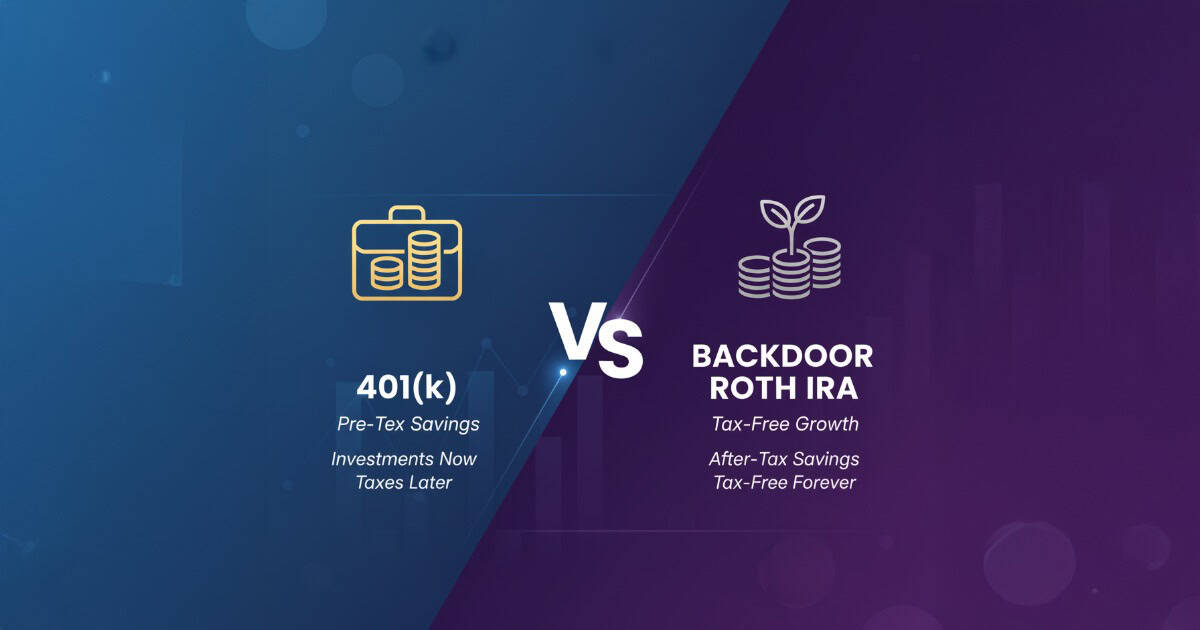
In the complex landscape of personal finance, few decisions carry as much long-term weight as how you save for retirement. For a long time, the traditional 401(k) was the undisputed king of retirement plans. But as incomes have risen and tax laws have evolved, a sophisticated new player has entered the arena: the Backdoor Roth IRA. This isn’t just a choice between two accounts; it’s a strategic decision that could determine the tax efficiency and ultimate size of your retirement nest egg. The choice between a 401(k) vs Backdoor Roth IRA is a critical one for high-income earners.
This in-depth guide from the experts at ComparisonMath.com is designed to provide high-income earners and savvy savers with the knowledge they need to master these two powerful financial instruments. We will go beyond the basics, diving deep into the tax implications of each, their rules, and the advanced strategies that allow them to work in perfect harmony. Our goal is to equip you with the expertise to confidently build a retirement portfolio that is both robust and tax-optimized.
Section 1: The Foundation of Retirement Savings - The 401(k)The 401(k) is the most common employer-sponsored retirement plan, and for good reason. It’s a straightforward, effective way to save for your future, with a clear tax benefit.
What is a 401(k)?A 401(k) is a defined contribution plan, meaning the amount you contribute is known, but the future value is dependent on investment performance. You, the employee, choose to contribute a percentage of your salary directly from your paycheck. The funds are then invested in a selection of mutual funds, ETFs, or other investment vehicles offered by your plan provider.
A key feature of many 401(k) plans is the employer matching contribution. Employers may match a portion of your contributions, for example, 50 cents on the dollar up to a certain percentage of your salary. This is often described as “free money,” and it’s a powerful incentive that should always be the first priority in your retirement savings strategy.
Understanding the Tax Implications of a Traditional 401(k)The traditional 401(k) operates on a “pay-taxes-later” model, which can be highly advantageous depending on your financial situation.
The Roth 401(k) AlternativeAs an alternative to the traditional pre-tax plan, many employers also offer a Roth 401(k). This option flips the tax treatment, offering a different kind of long-term tax advantage.

Updated 2025-2026 Contribution Limits & RulesStaying on top of IRS changes is crucial for maximizing your savings. Here are the key limits for the 2025 and projected 2026 tax years:
| Feature | 2025 Limit | Projected 2026 Limit |
| Employee Elective Deferral | $23,500 | $24,500 |
| Age 50+ Catch-Up Contribution | $7,500 | $8,000 |
| Age 60-63 Catch-Up (SECURE 2.0) | $11,250 | $11,500 |
| Total Contribution Limit (Employee + Employer) | $70,000 | $72,000 |
Note: The higher catch-up contribution limit for ages 60-63, introduced by the SECURE 2.0 Act, is a significant new opportunity for those nearing retirement to supercharge their savings.
Section 2: Demystifying the Backdoor Roth IRAThe Backdoor Roth IRA is not a formal account type but a legal two-step strategy used by high-income earners to get money into a Roth IRA. It’s a strategy that has become a staple of advanced retirement planning.
What is a Backdoor Roth IRA and Why Does It Exist?The motivation for the backdoor Roth strategy is simple: the IRS places income limits on who can contribute directly to a Roth IRA. For 2025, if your Modified Adjusted Gross Income (MAGI) is above $165,000 for single filers or $246,000 for those married filing jointly, you are completely phased out of making a direct contribution.
The backdoor strategy circumvents these income limits by exploiting two different sets of tax rules:
By executing these two steps sequentially, you can legally and efficiently fund a Roth IRA, regardless of your income level.
The Step-by-Step Backdoor Roth Conversion ProcessWhile the concept is simple, meticulous execution is key to avoiding tax pitfalls. Here’s how the process works:
To minimize the chance of any taxable gains, this conversion should happen as quickly as possible—ideally, within a day or two of the initial contribution. By doing so, any earnings that have accrued on the funds are negligible, and the conversion is effectively a zero-cost, non-taxable event.
The Pro Rata Rule: The Backdoor Roth's Biggest ObstacleWhile the process seems simple, there’s a significant complication known as the pro rata rule for backdoor Roth IRA conversions. This rule is a major reason why many people consult with a financial advisor before attempting the strategy.
What is the Pro Rata Rule? The IRS treats all of your non-Roth IRAs (Traditional, SEP, and SIMPLE IRAs) as a single, consolidated account for tax purposes. The pro rata rule dictates that any conversion to a Roth IRA must be a proportional mix of your pre-tax and after-tax funds across all of these accounts. You cannot simply convert only the after-tax money.
For example, if you have a $93,000 pre-tax rollover IRA from a previous job and you contribute $7,000 after-tax to a new traditional IRA, your total IRA balance is $100,000. If you then convert the new $7,000 to a Roth, the IRS will see that only 7% of your total IRA assets are after-tax. This means 93% of the $7,000 conversion, or $6,510, will be considered a taxable distribution from your pre-tax funds, resulting in an unexpected tax bill.
To avoid this trap, the best practice is to have a “clean” traditional IRA with a zero pre-tax balance before attempting a conversion. This is often achieved by rolling any existing pre-tax IRA funds into your current employer’s 401(k) if the plan allows. This maneuver, known as a reverse rollover, is a critical component of a successful backdoor Roth strategy for those with existing IRAs.
Section 3: The Ultimate Head-to-Head ComparisonNow that we’ve broken down each account individually, let’s put them side-by-side to understand where they excel. This is where you can begin to craft your personalized savings strategy.
| Feature | Traditional 401(k) | Roth 401(k) | Backdoor Roth IRA |
|---|---|---|---|
| Contribution Limits | $23,500 (employee) + match; up to $70,000 total | $23,500 (employee) + match; up to $70,000 total | $7,000 |
| Tax Treatment | Pre-tax contributions, tax-deferred growth, taxable withdrawals | After-tax contributions, tax-free growth, tax-free withdrawals | After-tax contribution, tax-free growth, tax-free withdrawals |
| Income Limits | None (for contributions) | None (for contributions) | Used to bypass income limits for direct Roth IRA contributions |
| Employer Match | Yes, a primary benefit | Yes, but the match is always pre-tax | No |
| Flexibility | Limited investment options; controlled by employer | Limited investment options; controlled by employer | Full control over investment options; self-managed |
| RMDs | Yes, starting at age 73 | No, during the original owner’s lifetime | No, during the original owner’s lifetime |
The Core Tax Strategy: Choosing the Right AccountChoosing between these accounts comes down to one core question: do you think you will be in a higher tax bracket today or in retirement?
Section 4: The Ultimate Hybrid Strategy: Using Both AccountsFor the truly savvy saver, the battle between a 401(k) and a backdoor Roth IRA isn’t a zero-sum game. The most powerful strategy is to use both accounts in a deliberate sequence to maximize your savings and tax advantages.
Here is the step-by-step approach recommended by financial planners for high-income earners:
Section 5: Common Pitfalls and Expert InsightsEven with a clear strategy, there are critical details that can make or break your retirement plan.
The Pro Rata Rule in Practice: A Deeper DiveThe pro rata rule is the most common reason for a failed backdoor Roth IRA. The simple solution is to ensure your traditional IRA balance is zero before you begin the conversion process.
The 5-Year Rule for Roth IRA ConversionsUnderstanding the 5-year rule is crucial for avoiding an early withdrawal penalty. While contributions can be withdrawn at any time penalty-free, conversions have a different rule:
The Tax Filing Requirement: Form 8606Failing to file IRS Form 8606 is a common and costly mistake. This form tracks your basis in non-deductible traditional IRA contributions. Without it, the IRS has no record that you’ve already paid taxes on the money, and they may assume the entire converted amount is pre-tax, leading to a surprise tax bill. Always file this form every year you make a non-deductible contribution, even if you convert it immediately.
Section 6: Case Studies and Recommendation MatrixLet’s apply these strategies to real-world scenarios to illustrate how different savers can optimize their plans.
Conclusion: Building a Retirement Portfolio, Not Just an AccountThe financial planning journey for high-income earners is no longer a one-size-fits-all approach. The question is not simply 401(k) vs Backdoor Roth IRA, but rather, how can these two powerful tools be used in concert to build a truly optimized and tax-efficient retirement portfolio?
Our in-depth analysis confirms that the best strategy for the majority of people is a hybrid approach. Start with the certainty of your employer’s matching contributions, then use the backdoor Roth to unlock a future of tax-free growth. By understanding and actively managing the tax implications, and being aware of pitfalls like the pro rata rule, you can move beyond basic savings and build a retirement strategy that positions you for long-term financial independence.
Frequently Asked Questions (FAQ) - Backdoor Roth and 401(k)Yes, absolutely. They are separate types of retirement accounts with different contribution limits and rules. For most high-income earners, contributing to both is the most effective way to save as much as possible for retirement.
No. The strategy is primarily for those who are phased out of making a direct Roth IRA contribution due to their income. For those with lower incomes, a direct Roth IRA contribution is simpler and just as effective. Additionally, it is not recommended for individuals with a large existing pre-tax IRA balance who cannot roll it into a 401(k), as the pro rata rule would result in a significant tax bill.
The Mega Backdoor Roth is an advanced strategy that allows for a massive influx of after-tax funds into a Roth account, far exceeding the standard IRA limit. It is only possible if your employer’s 401(k) plan specifically allows for both after-tax contributions and in-plan Roth conversions. You must check with your plan administrator to determine eligibility.
A traditional IRA to Roth IRA conversion can be done by anyone, and it typically involves converting pre-tax funds to a Roth IRA, which triggers a taxable event. A backdoor Roth is a specific two-step strategy used by high-income earners to get money into a Roth IRA when they are over the income limits for a direct contribution. When done correctly, the backdoor process has a minimal or zero tax impact.
An employer match does not count toward your personal employee contribution limit, which is $23,500 for 2025. However, it does count towards the overall total contribution limit for your account, which is $70,000 for 2025 (employee contributions + employer match + any after-tax contributions).
Prices and features mentioned are accurate as of the date of publication. Always check the official provider website for the most current pricing and availability.