The landscape of business technology is in the midst of a profound shift. For decades, the path to enterprise automation was a long, often winding road paved with custom code, complex integrations, and the deep expertise of a specialized few. But today, the rules are changing. The combination of low-code automation and sophisticated agentic AI workflows is not just an incremental improvement; it’s a revolutionary force that is democratizing digital transformation.
This guide is designed for business leaders, non-technical teams, and even technical leaders who want to understand how to leverage this powerful synergy. We will demystify the core concepts, provide a clear blueprint for implementation, and show you how to architect intelligent systems that go beyond simple task automation to truly autonomous, goal-oriented work. By the end of this article, you will have a clear understanding of how to build, deploy, and scale low-code AI automation within your organization.
Part 1: Deconstructing the Core Concepts
To truly appreciate the power of this new paradigm, we must first define our terms. What exactly are we talking about when we say “low-code automation” and “agentic AI”?
What is Low-Code Automation?
At its heart, low-code automation is a method of developing applications and workflows using visual tools with minimal hand-coding. Instead of writing thousands of lines of code, users interact with a graphical user interface (GUI) to drag-and-drop pre-built components, connect logical nodes, and configure process flows.
This approach is the logical evolution of earlier automation technologies like Business Process Management (BPM) and Robotic Process Automation (RPA). While RPA excelled at automating repetitive, rule-based tasks (e.g., scraping data from a website), modern low-code platforms have incorporated powerful new capabilities. They offer a flexible foundation for building sophisticated applications, not just simple bots. This is what enables a subject-matter expert, or a “citizen developer,” to create a complex business solution that previously would have required a professional software engineer. It’s a key part of the larger movement to democratize technology and empower teams.
Understanding Agentic AI
If low-code provides the framework, agentic AI provides the intelligence. An AI agent is not just a tool that responds to a prompt, like most generative AI models. Instead, it is an autonomous system that can perceive its environment, formulate a plan to achieve a specific goal, and take a series of actions to execute that plan all with limited or no human supervision.
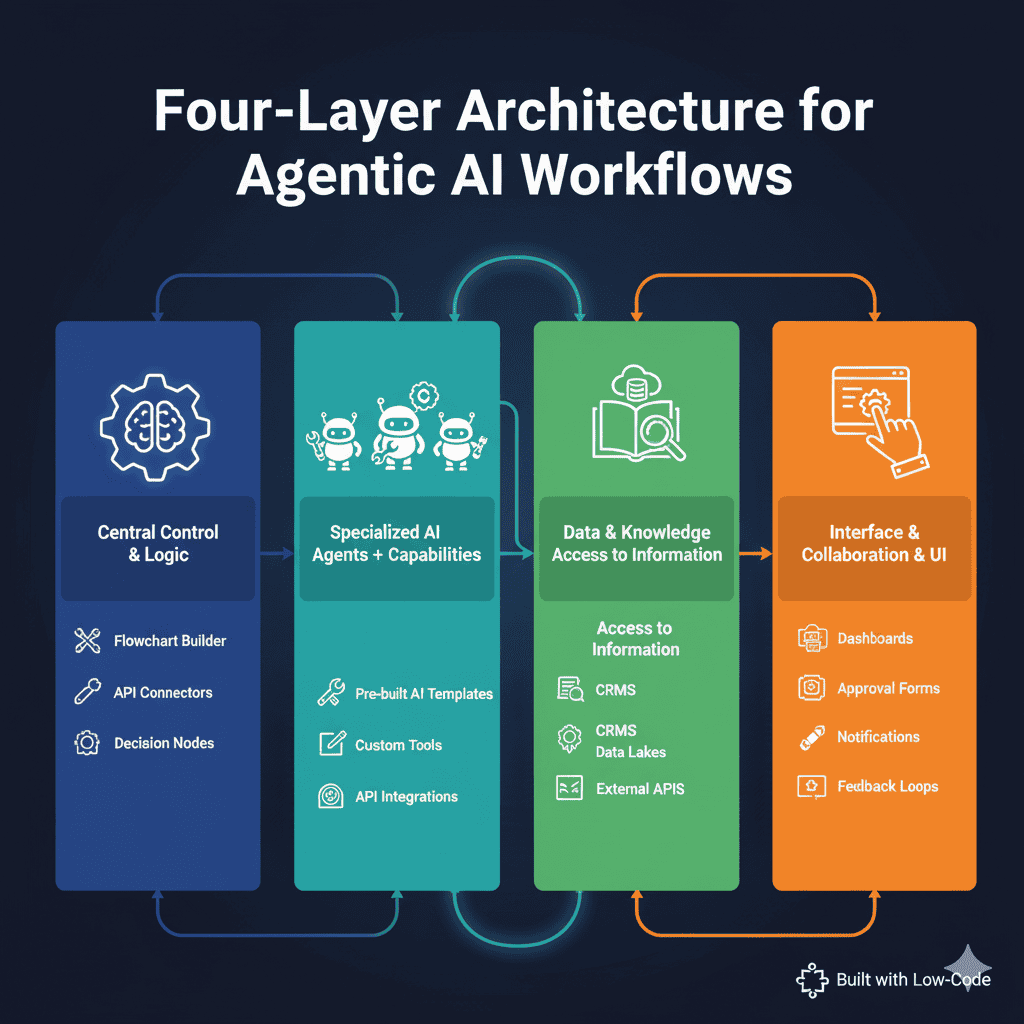
The Four-Layer Architecture for Agentic AI Workflows. This infographic provides a clear, conceptual model for building a robust and scalable low-code AI automation system.
Let’s break down the key components of an AI agent that differentiate it from its generative counterpart:
Goal: The ultimate objective the agent must achieve. This could be anything from “research the top 5 competitors for a new product” to “resolve a customer support ticket.”
Planner/Reasoning Engine: This is the “brain” of the agent. It takes the goal and breaks it down into a series of actionable steps. This is where the magic happens, as the agent can adapt its plan in real time based on new information.
Tools: These are the “hands” of the agent. Tools are predefined functions or API integrations that allow the agent to interact with the outside world. This could be a tool to send an email, query a database, or perform a web search.
Memory: The agent must be able to remember past actions and their outcomes to avoid repeating mistakes and maintain context.
Reflection: After completing a task or encountering an error, the agent can reflect on its performance to improve its future plans.
This is the fundamental distinction: while generative AI is excellent at content creation based on a prompt, an AI agent takes that capability and embeds it into an autonomous system that can execute an entire business process automation AI flow from start to finish.
Part 2: The Symbiotic Relationship: Low-Code Meets Agentic AI
The real power lies in the marriage of these two concepts. Low-code platforms provide the perfect environment for orchestrating and managing the complexity of agentic AI.
Why Low-Code is the Catalyst for Agentic AI Adoption
The widespread adoption of low-code automation is critical for unleashing the potential of agentic AI for two primary reasons:
Democratization of Development: The traditional path to building an AI agent requires specialized knowledge in programming languages, machine learning frameworks, and complex API integrations. Low-code platforms strip away this complexity by providing a visual, drag-and-drop interface. This empowers non-technical teams and business analysts to become active participants in the AI agent development low-code process, accelerating innovation and ensuring solutions are built by the people who best understand the business problem.
Rapid Prototyping and Iteration: The visual nature of low-code allows teams to build, test, and refine complex multi-agent systems in days, not months. This speed is crucial for a technology as nascent as agentic AI, as it enables quick experimentation and learning. You can test a hypothesis, see if an agent’s logic holds up, and make adjustments on the fly, dramatically shortening the time from idea to a working prototype.
The Architectural Framework for Agentic AI Workflows
Architecting a robust agentic AI workflow is about more than just plugging in an AI model. A successful system requires a well-defined structure. We recommend a four-layer model to guide your design process, ensuring you cover all the necessary components.
Orchestration Layer: This is the central brain and coordinator of your workflow. It’s responsible for managing the overall goal, the sequence of tasks, and the communication between different agents and tools. This is where you configure the logic that determines what happens next. Platforms like n8n or Microsoft Power Automate, with their sophisticated AI capabilities, serve as excellent orchestration hubs.
Agent & Tool Layer: This layer contains the individual AI agents and the specific tools they can use. Each agent has a specialized role (e.g., a “research agent,” a “data extraction agent,” a “customer service agent”). The tools are the APIs or custom functions that allow these agents to perform actions in external systems, such as a CRM, an ERP, or an email service.
Data & Knowledge Layer: No AI agent can function without data. This layer connects your workflow to internal data sources (databases, data lakes, CRMs) and external knowledge bases. This is where agents get the information they need to reason and make decisions. This could include a vector database for Retrieval Augmented Generation (RAG) or simply an API endpoint for a legacy system.
Interface & Collaboration Layer: While AI agents are autonomous, they are not isolated. This layer defines the “human-in-the-loop” checkpoints, where a human user can review, approve, or override an agent’s decision. This is crucial for maintaining quality, ensuring compliance, and building trust in your automated systems. It also includes the user interface (UI) that allows your team to interact with and monitor the workflow.
Part 3: A Step-by-Step Blueprint for Building Your Agentic Workflow
Ready to get started? Follow this practical blueprint to build your first low-code automation with an agentic AI component.
Phase 1: Planning and Discovery
This is arguably the most critical phase. An automation project is only as good as the problem it solves.
Identify a High-Value, Automatable Process: Start small with a well-defined process that is repetitive, time-consuming, and has a clear, measurable outcome. A good candidate is something like “automating the lead qualification process” or “triaging inbound customer support tickets.”
Map the Current Workflow: Visually map out the existing process, identifying all the manual steps, pain points, and human-in-the-loop decision points. This will be your baseline for measuring success and a guide for building your automated version.
Choosing the Right Low-Code AI Platform: Not all platforms are created equal. When selecting a low-code AI platform, look for one that offers:
Robust AI capabilities: Does it have native connectors to the latest AI models?
Extensive integrations: Can it connect to all the tools you already use (e.g., Salesforce, Slack, Google Sheets)?
Visual workflow builder: Is the interface intuitive enough for your team?
Scalability and Governance: Can it grow with you and provide the necessary security features?
Phase 2: Building and Configuration
With your blueprint and platform in hand, it’s time to build.
Define the Primary Objective and Sub-Tasks: In your low-code builder, set the main goal for your workflow. For example, “Qualify new leads from our contact form.” Then, define the sub-tasks: “Fetch new lead data,” “research the company and contact online,” “analyze the company’s size and industry,” “score the lead,” and “notify the sales team.”
Configure Agents and Connect to Tools: Use the platform’s drag-and-drop interface to add nodes for each sub-task. Connect to your contact form via an API. Use an AI agent node to perform the research and analysis steps, giving it access to tools like a web search API or a data enrichment service.
Setting up the “Human-in-the-Loop” Checkpoints: Place an approval node after the lead scoring step. This ensures that the AI’s final recommendation is reviewed by a human before the sales team is notified. This builds confidence and provides a crucial safety net.
Phase 3: Deployment, Monitoring, and Iteration
Your workflow is built, but the job is not done.
Deploy the Initial Workflow (POC): Start with a small-scale proof-of-concept (POC) on a limited data set. This allows you to catch any errors and validate the logic without risking live production data.
Establish Performance Metrics: Track key metrics like “time saved per lead,” “accuracy of lead scores,” and “reduction in manual errors.” These metrics will demonstrate the tangible return on investment (ROI).
The Importance of Continuous Feedback and Refinement: Agentic AI is not a set-it-and-forget-it technology. Use the monitoring data and feedback from your team to continuously refine the workflow. Adjust the agent’s instructions, add new tools, or modify the human-in-the-loop checkpoints to improve performance over time.
Part 4: Real-World Agentic AI Use Cases by Department
To illustrate the immense potential of low-code agentic AI, let’s look at practical examples across different business functions.
Marketing & Sales:
Agentic lead nurturing: An AI agent can automatically research new leads, personalize email outreach campaigns based on the lead’s industry and interests, and schedule follow-up tasks for sales reps.
Content creation: A content-focused agent can research a topic, draft an article outline, and even write a first draft, all triggered by a simple request from a marketing manager.
Customer Support:
Intelligent ticket triaging: An AI agent can read incoming support tickets, automatically categorize them by urgency and topic, and route them to the most appropriate team member, significantly reducing response times.
Automated resolution: For common queries, an agent can autonomously look up the answer in a knowledge base and provide a resolution without human intervention.
Human Resources:
Onboarding workflows: A series of agents can automate new employee onboarding, from creating user accounts and sending welcome emails to assigning training modules and collecting necessary documents.
Finance:
Invoice processing automation: An agent can monitor an inbox for new invoices, extract key data points (vendor, amount, due date), cross-reference them with purchase orders in an ERP system, and route them for approval, all without a single keystroke.
Part 5: Overcoming Challenges & Future-Proofing Your Strategy
While the benefits are clear, no transformative technology is without its challenges. Addressing these head-on is crucial for success.
Security and Data Privacy
One of the most significant concerns with any AI-driven system is security. When dealing with sensitive business data, you must ensure that your low-code AI security risks are mitigated. Key considerations include:
Vendor Trust: Choose a platform that has robust security features, including data encryption, secure user authentication, and compliance with industry standards like GDPR and HIPAA.
Access Control: Implement granular role-based access control to ensure that only authorized users and agents can access specific data.
Auditing and Monitoring: Regularly audit your workflows and API calls to monitor for unusual activity and ensure data is being handled correctly.
Governance and Scalability
As your low-code implementation grows, a lack of governance can lead to “shadow IT” and data inconsistencies.
Center of Excellence (CoE): Establish a CoE to standardize best practices, provide training, and oversee all low-code projects.
Start Small, Scale Smart: Begin with a high-impact but low-risk project to prove the value and build momentum. Once successful, you can use that blueprint to tackle larger, more complex business process automation AI challenges.
The Human Element
The fear that AI will replace jobs is a common one. A successful strategy focuses on reskilling, not replacing, your workforce.
Citizen Developer Programs: Empower your business teams with training and support to become citizen developers, turning them from consumers of technology into creators.
Focus on Strategic Tasks: By automating mundane, repetitive tasks, you free up your team to focus on strategic, creative, and high-value work that requires human judgment.
Evergreen Content Potential
This guide is structured to remain a relevant resource. It’s a foundational framework for understanding the core principles of low-code and agentic AI. As technology evolves, we will update sections on specific low-code AI platform examples and emerging AI agent frameworks to ensure the information remains current and useful for years to come.
Conclusion: The Future is Here, and It’s Low-Code
The days of monolithic, custom-coded software being the only solution for complex business problems are over. The convergence of low-code automation and agentic AI workflows represents a new era of agile, accessible, and intelligent automation.
For Business Leaders: The key takeaway is to focus on strategic value, not technical complexity. The tools are now available to empower your teams to solve business problems with unprecedented speed and efficiency.
For Non-Technical Teams: You are no longer on the sidelines of digital innovation. The power to create sophisticated, intelligent solutions is now within your grasp. Embrace a “citizen developer” mindset and start experimenting.
For Technical Leaders: Low-code does not diminish your role; it elevates it. You are now the architects of the core infrastructure, governance, and security that enables a new wave of innovation, ensuring your organization can scale its low-code automation efforts safely and effectively.
The right low-code tools are not a replacement for human ingenuity, but an amplifier. They are the key to unlocking the true potential of agentic AI workflows and building the resilient, efficient, and intelligent businesses of the future. The time to start is now.
Frequently Asked Questions (FAQ) – Low-Code Agentic AI
What’s the difference between agentic AI and a regular chatbot?
A regular chatbot is typically a simple program that follows a predefined script to respond to a user’s query. It’s reactive and has a single-turn purpose. Agentic AI, on the other hand, is a proactive, goal-oriented system. It can break down a complex objective into multiple steps, use various external tools (like APIs and databases), and make decisions autonomously to achieve a goal. Think of a chatbot as a dictionary and an AI agent as a research assistant.
Can non-technical people really build complex AI workflows?
Yes, that is the core promise of low-code AI automation. While a foundational understanding of your business processes and logic is required, the technical barrier of traditional coding is removed. Low-code platforms use visual, drag-and-drop interfaces that allow non-technical teams to design and deploy sophisticated workflows by connecting pre-built components and configuring the logic, all without writing a single line of code.
How much does it cost to implement a low-code AI automation solution?
The cost of low-code AI automation is a key benefit, as it is often a fraction of the cost of a traditional custom-coded solution. Most low-code AI platform providers offer tiered pricing models, with costs ranging from a low monthly subscription for small-scale use to enterprise-level plans that include premium features, enhanced security, and dedicated support. The main cost benefits come from the significant reduction in development time and the ability to scale your automation efforts without hiring a large team of specialized developers.
What are some examples of low-code platforms for building AI agents?
In 2025, the market for platforms with robust AI agent capabilities is maturing rapidly. Examples of leading platforms include Microsoft Power Automate, Appian, and n8n, which all offer extensive visual builders, pre-built AI connectors, and support for multi-agent orchestration. The key is to evaluate a platform’s features, scalability, and security to find the one that best fits your specific business needs.
Is low-code automation secure for handling sensitive business data?
When chosen carefully, low-code platforms are just as secure as traditional software. Most enterprise-grade platforms offer robust security features, including end-to-end data encryption, audit logs, and strong access controls. However, the responsibility also lies with the user to configure these features correctly. Implementing a strong governance framework and a “human-in-the-loop” model for sensitive tasks is crucial for mitigating potential low-code AI security risks and ensuring compliance.
Prices and features mentioned are accurate as of the date of publication. Always check the official provider website for the most current pricing and availability.