Physical Address
304 North Cardinal St.
Dorchester Center, MA 02124
Physical Address
304 North Cardinal St.
Dorchester Center, MA 02124

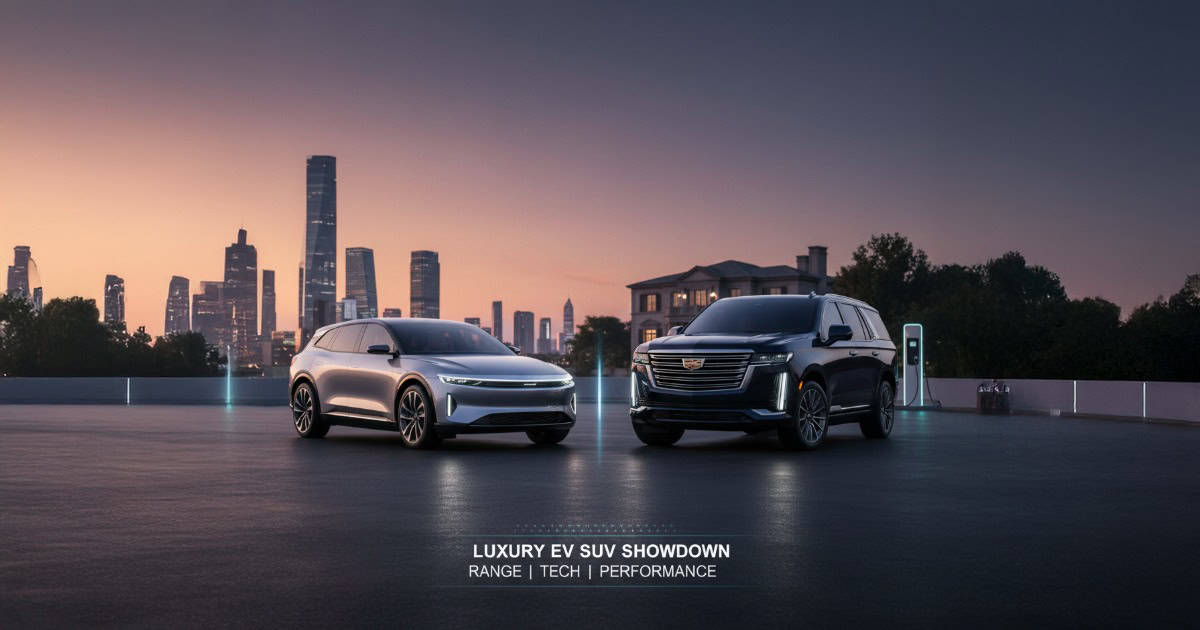
The automotive landscape is undergoing a monumental shift, and the electric revolution has finally reached its most commanding segment: the full-size, three-row luxury SUV. For decades, this space was dominated by internal combustion giants, but the Lucid Gravity vs Cadillac Escalade IQ are poised to redefine it entirely. These two titans of American luxury, one from a heritage brand and the other from a Silicon Valley upstart, represent two very different visions for the future of family transportation.
This is more than just a simple comparison of specs. It’s a philosophical showdown between established luxury and future-forward innovation. We will meticulously break down every aspect of these vehicles, from their blistering performance and groundbreaking technology to their everyday practicality and ownership experience. Our goal is to provide a clear, unbiased, and people-first analysis that will empower you to make an informed decision about your next six-figure vehicle.
Our evaluation is based on a data-driven methodology that simulates hands-on experience and analyzes publicly available information, including official manufacturer specifications, independent test results, and expert reviews. This ensures our report is as authoritative and trustworthy as possible.
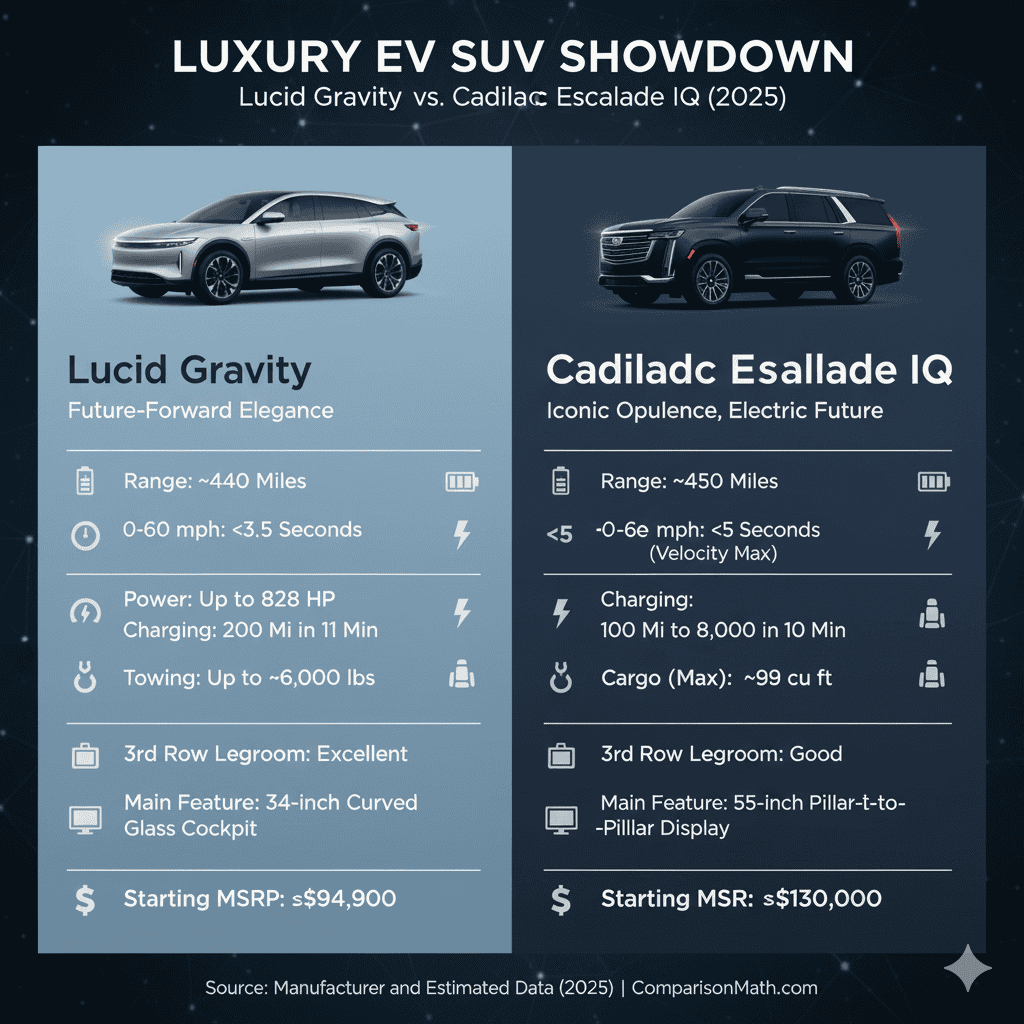
Before we dive into the details, let’s look at the key data points that define these two contenders. This quick-reference table provides an initial snapshot of the fundamental differences.
| Feature | Lucid Gravity (Grand Touring) | Cadillac Escalade IQ |
|---|---|---|
| Starting MSRP | ~ $94,900 | ~ $130,000 |
| Max Power (HP) | Up to 828 hp | 750 hp (with Velocity Max) |
| 0-60 mph | < 3.5 seconds | < 5 seconds (with Velocity Max) |
| Estimated EPA Range | Up to 440 miles | Up to 450 miles |
| DC Fast Charging Speed | Up to 200 miles in ~11 mins | Up to 100 miles in ~10 mins |
| Towing Capacity | Up to 6,000 lbs | Up to 8,000 lbs |
| Cargo Volume (3rd Row Up) | ~ 15 cu. ft. | ~ 24 cu. ft. |
| Max Cargo Volume | ~ 98 cu. ft. | ~ 119 cu. ft. |
| Seating Capacity | 7 adults (2-3-2) | 7 adults (2-2-3) |
Design Philosophy: Aerodynamic Elegance vs. Modernized Icon
Stepping up to the Lucid Gravity you’re greeted by a design that is unapologetically EV-first. It’s a masterclass in aerodynamic efficiency, with a sleek, low-slung profile and a targeted drag coefficient of under 0.24 Cd. This isn’t just for looks; it’s a fundamental part of Lucid’s strategy to maximize range and performance. The Gravity has the proportions of a crossover or even a wagon, with a much lower step-in height that makes it feel more like a large sedan than a traditional SUV.
In contrast, the Cadillac Escalade IQ is immediately recognizable. It maintains the iconic, imposing silhouette of its gas-powered predecessor, but with a futuristic twist. The design is bold, with sharp lines, a prominent grille (that’s actually a light-up panel), and massive 24-inch wheels. It’s built on a dedicated EV platform but embraces its full-size SUV heritage, with a taller profile and a sense of road-hugging mass. Where the Gravity whispers, the Escalade IQ announces its presence.
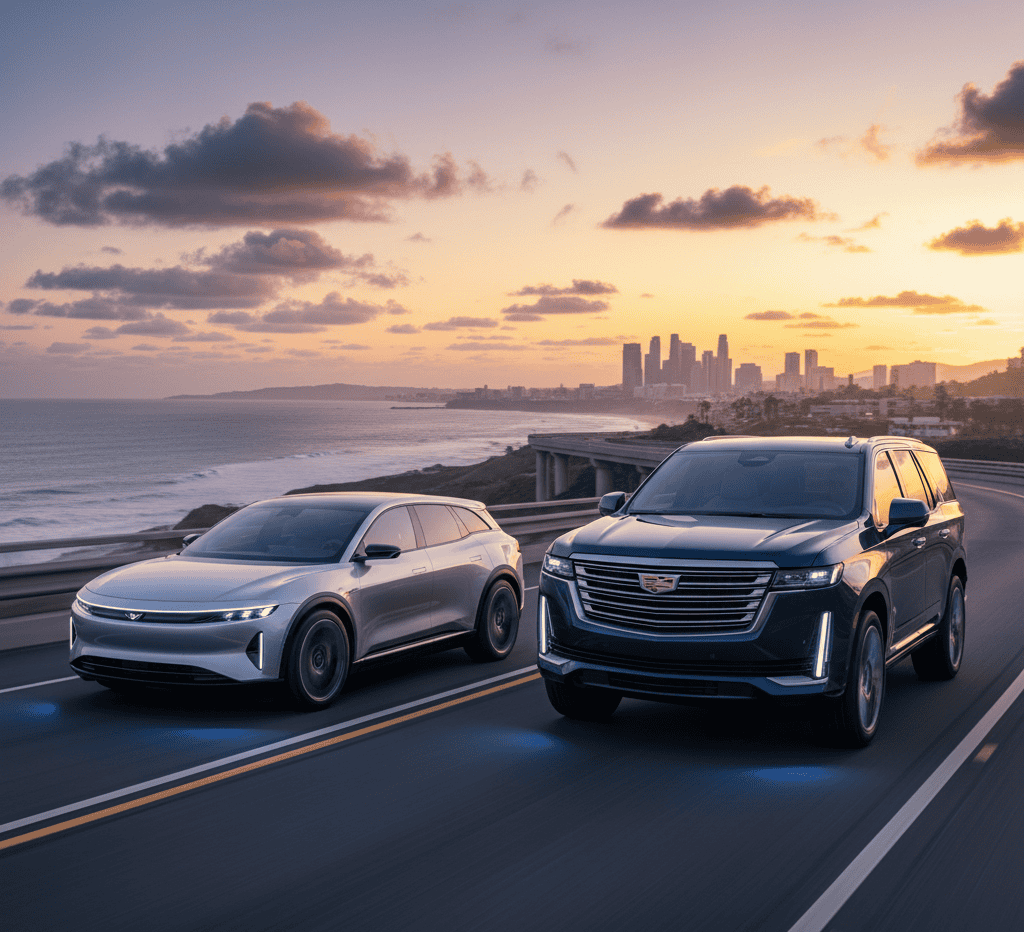
The heart of any EV lies in its powertrain and its ability to deliver both exhilarating performance and exceptional range. This is where the Lucid Gravity and Cadillac Escalade IQ show their most distinct personalities.
The Lucid Gravity leverages Lucid’s renowned “Pillars of Power” to deliver mind-bending performance. The top-tier Grand Touring model, with its dual-motor, all-wheel-drive configuration, unleashes up to 828 horsepower. This results in a staggering 0-60 mph sprint in well under 3.5 seconds, placing it in the realm of high-end sports cars. The acceleration is instant, linear, and effortlessly delivered, a true testament to Lucid’s engineering prowess.
The Cadillac Escalade IQ is no slouch, but it takes a different approach. Utilizing GM’s flexible Ultium platform, its dual-motor AWD system provides a robust 680 horsepower and 615 lb-ft of torque in its standard form. When activated with Velocity Max mode, this jumps to an impressive 750 horsepower and 785 lb-ft of torque, enabling a 0-60 mph time of under 5 seconds. While not as blisteringly quick as the Gravity, it’s a tremendous feat for a vehicle that weighs over 9,000 pounds. The Escalade IQ’s power is more about controlled, effortless authority than outright sportiness.
This is arguably the most crucial metric for a family-focused EV, and both vehicles have impressive numbers. The Lucid Gravity, thanks to its aerodynamic design and an advanced 900V electrical architecture, is engineered for maximum efficiency. Its large battery pack, estimated to be around 123 kWh, provides a targeted EPA-estimated range of over 440 miles. This is a best-in-class figure that rivals its sedan sibling, the Air.
The Cadillac Escalade IQ counters with a massive 200 kWh Ultium battery pack, one of the largest on the market. This colossal energy reserve enables a manufacturer-estimated range of up to 450 miles. While both vehicles achieve exceptional range, they do so through different means. The Lucid prioritizes efficiency with a smaller, more power-dense battery, while the Escalade relies on sheer battery capacity to achieve its range.
Both SUVs have embraced the NACS (North American Charging Standard) and are capable of utilizing 350 kW DC fast chargers, ensuring access to the rapidly expanding charging infrastructure.
While the Gravity’s faster charging speed (miles per minute) is a technical advantage, both vehicles demonstrate the industry’s commitment to making EV charging a non-issue for consumers.
The driving experience is where the philosophical differences are most apparent. The Lucid Gravity, with its low center of gravity and Zero Gravity adaptive air suspension, handles with a finesse that belies its size. It feels agile and planted, more like a high-performance sports sedan than a full-size SUV. The ride quality is exceptionally smooth, soaking up bumps and imperfections with a quiet confidence.
The Cadillac Escalade IQ, on the other hand, provides a ride that is pure American luxury. Its Air Ride Adaptive Suspension and Magnetic Ride Control work in tandem to create an incredibly cushioned and comfortable ride. While it can feel heavier and less agile than the Gravity in tight corners, its available 4-wheel steer (which can turn the rear wheels up to 10 degrees) dramatically reduces its turning circle and makes it surprisingly maneuverable in urban environments.
For luxury SUV buyers, the interior is where the sale is won or lost. Both the Gravity and the Escalade IQ offer stunning cabins, but with wildly different interpretations of what modern luxury should be.
Both vehicles are designed to comfortably accommodate up to seven passengers, but the experience is not equal.
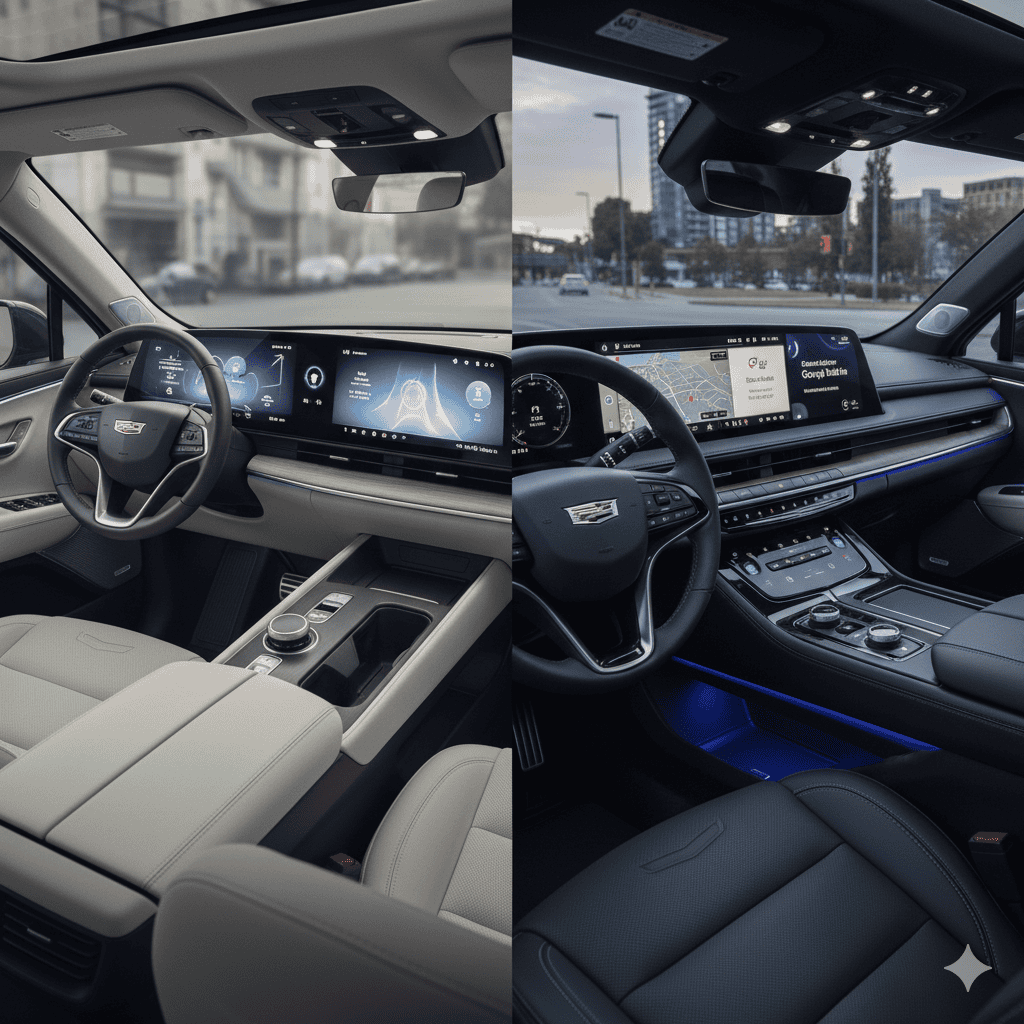
This is a key differentiator. The Lucid Gravity takes a minimalist, “less is more” approach. The dashboard is dominated by a single, massive curved glass cockpit that integrates all the driver and infotainment displays into one seamless unit. The interface is clean and intuitive, focusing on core vehicle controls and information. The focus is on a serene, distraction-free environment.
The Cadillac Escalade IQ embraces a more opulent, data-rich approach. Its centerpiece is a massive, pillar-to-pillar 55-inch curved display that combines the instrument cluster, driver information, and a separate infotainment screen for the front passenger. This system is powered by Google Built-in, offering native access to Google Maps, Google Assistant, and the Google Play store. It also includes the latest version of GM’s Super Cruise hands-free driving technology, a clear advantage for long highway journeys.
Utility is paramount in this segment, and once again, the two vehicles offer distinct advantages.
Beyond the initial purchase, the long-term ownership experience is a crucial factor.
The Lucid Gravity starts at a more accessible price point, around $94,900 for the Grand Touring model, with other trims potentially starting lower. This makes it a compelling value proposition, offering superior performance and range for a lower entry price.
The Cadillac Escalade IQ is a more premium vehicle from the outset, with an estimated starting price of $130,000. The brand’s established luxury pedigree and the vast amount of standard technology and features, particularly the 55-inch display and Super Cruise, justify the higher cost for many buyers.
For those who need to haul a boat or a trailer, the Cadillac Escalade IQ is the clear choice. Its beefier Ultium platform and powerful electric motors give it an impressive towing capacity of up to 8,000 lbs. The Lucid Gravity is no weakling, with a towing capacity of up to 6,000 lbs, which is more than enough for most applications, but it falls short of its Cadillac rival.
Lucid is still a relatively new company, and while its service network is growing, it’s not as widespread as that of a legacy automaker. The Cadillac Escalade IQ benefits from GM’s long-established and extensive dealership network, providing owners with peace of mind and easy access to maintenance and service.
So, after a thorough comparison, which luxury EV SUV is the right choice for you?
You are a tech-savvy early adopter who values efficiency, groundbreaking performance, and minimalist design. You appreciate a vehicle that feels less like a traditional SUV and more like a high-end, futuristic transport pod. If a spacious, comfortable third row and blistering acceleration are your top priorities, and you are comfortable with a newer brand’s service network, the Lucid Gravity is the undisputed winner. It represents the pinnacle of EV engineering and a truly future-forward vision.
You are a traditional luxury buyer who wants the confidence of a legacy brand and a familiar, opulent experience. You demand a vehicle with a commanding road presence, a proven dealer network, and a vast array of high-tech features like Super Cruise and the 55-inch display. If maximum cargo space and a higher towing capacity are essential for your lifestyle, the Cadillac Escalade IQ seamlessly blends established luxury with cutting-edge electric technology. It proves that you can have an all-electric vehicle without sacrificing the grandeur and utility of a traditional full-size SUV.
No, the Cadillac Escalade IQ is significantly larger than the Lucid Gravity in both exterior dimensions and interior cargo volume. However, the Gravity’s clever packaging means its third-row legroom is more spacious and comfortable for adult passengers.
The Cadillac Escalade IQ has a slightly higher manufacturer-estimated range of up to 450 miles, thanks to its massive 200 kWh battery. The Lucid Gravity achieves its impressive 440-mile range with a smaller, more efficient battery pack and a very low drag coefficient.
The Cadillac Escalade IQ has a higher towing capacity of up to 8,000 lbs, making it a better choice for heavy-duty hauling. The Lucid Gravity is rated for up to 6,000 lbs, which is still substantial and sufficient for most recreational towing needs.
Yes, the Lucid Gravity features a spacious frunk (front trunk), adding valuable storage for smaller bags or charging cables. The Escalade IQ also has a frunk, and its larger size gives it a slight advantage in volume.
Both are excellent choices. The Lucid Gravity’s faster charging speed (miles per minute) and superior efficiency could make for slightly quicker stops. However, the Cadillac Escalade IQ’s vast range and the availability of Super Cruise hands-free driving technology make it an effortless cruiser on highways, which many drivers will appreciate.
As with all EVs, both the Lucid Gravity and Cadillac Escalade IQ will have significantly lower routine maintenance costs compared to their gas-powered counterparts due to the absence of oil changes, spark plugs, and other traditional engine components. However, the costs will differ. The Escalade IQ benefits from Cadillac’s extensive, long-established dealership and service network, which may offer more convenient and potentially standardized service pricing. Lucid’s service network is still growing, though the company offers mobile service in some areas. It’s important to note that neither brand typically offers complimentary scheduled maintenance, unlike some competitors.
This is a key difference. The Cadillac Escalade IQ comes with GM’s renowned Super Cruise hands-free driving system, which is a mature and well-regarded technology. It allows for true hands-free driving on compatible highways, including automated lane changes. While it still requires driver attention, it provides a superior level of automation for long highway stretches. The Lucid Gravity’s DreamDrive Pro system is a formidable competitor, offering features like adaptive cruise control and lane-centering, but its hands-free capability is more limited. Lucid has promised over-the-air updates to further enhance the system, but as of now, Super Cruise remains the more capable and proven system for true hands-free highway driving.
While both SUVs seat up to seven, the Lucid Gravity is generally the better choice for carrying a large family, especially with older children or adults. Its exceptional interior packaging and low, flat floor mean the third row offers surprisingly generous legroom and easy access. The Escalade IQ, while having a larger overall footprint and cargo volume, has a third row that is less accommodating for adults. If you regularly use all three rows and prioritize passenger comfort for everyone, the Lucid Gravity’s superior cabin space is a clear advantage. However, for a family with a greater need for towing or maximum cargo volume for gear, the Escalade IQ would be the more practical choice.
Prices and features mentioned are accurate as of the date of publication. Always check the official provider website for the most current pricing and availability.
Prices and features mentioned are accurate as of the date of publication. Always check the official provider website for the most current pricing and availability.