Physical Address
304 North Cardinal St.
Dorchester Center, MA 02124
Physical Address
304 North Cardinal St.
Dorchester Center, MA 02124

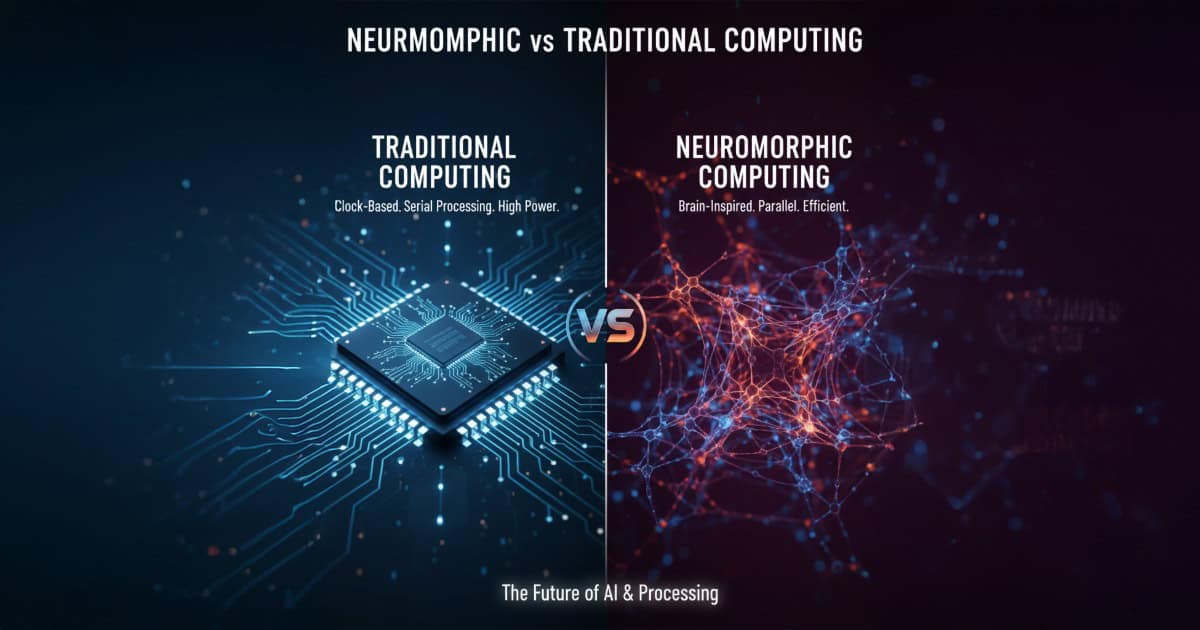
An interactive exploration into two fundamentally different approaches to computation. Discover the brain-inspired parallel processing of neuromorphic systems and the sequential logic of traditional von Neumann machines that power our digital world.
This section breaks down the foundational differences between the two paradigms. Explore how they handle processing, memory, and learning at the most basic level to understand why they excel at different types of tasks.
Based on the von Neumann architecture, with separate units for processing (CPU) and memory (RAM). Data is shuttled back and forth, creating a potential bottleneck.
Sequential and centralized. The CPU executes instructions one after another at very high speeds, driven by a clock. It excels at precise, mathematical calculations.
Memory and processing are physically separate. Data’s location in memory is distinct from where it is processed, requiring constant data transfer over a bus.
Relies on explicitly programmed algorithms. Machine learning models are trained through processes like backpropagation, requiring vast datasets and significant energy.
Inspired by the brain’s structure. Processing and memory are co-located in a vast network of artificial neurons and synapses, eliminating the von Neumann bottleneck.
Parallel and distributed. Thousands of simple processors (neurons) operate simultaneously and asynchronously, communicating via spikes. Ideal for pattern recognition and sensory data.
Memory is part of the processing fabric. The strength of synaptic connections (weights) encodes information, meaning memory is distributed and inseparable from computation.
Employs brain-inspired learning rules like Spike-Timing-Dependent Plasticity (STDP). Systems can learn continuously and adapt from sparse data streams with low power.
Visualize the data flow and structural differences that define each computing model. The traditional approach separates tasks, while the neuromorphic model integrates them. Hover over or tap the components below to learn about their roles in the system.
Hover over a component to see its description here.
Performance is not one-size-fits-all. The best computing approach depends heavily on the task. Use the filters below to see how these paradigms compare on different workloads across key metrics like power efficiency and fault tolerance.
(Lower is better)
(Higher is better)
(Higher is better)
Where do these technologies shine? Some tasks demand the precision of traditional systems, while others benefit from the adaptive, low-power nature of neuromorphic chips. Filter the applications below to see the best fit for each job.
The journey is far from over. While traditional computing continues to evolve, neuromorphic technology is rapidly maturing. Explore the challenges it faces and the potential future where both paradigms work together to solve humanity’s most complex problems.
The most likely future isn’t a replacement, but a collaboration. Imagine a future where:
Get quick answers to the most common questions about the two computing paradigms.
+
Neuromorphic systems are designed for extreme power efficiency. They use a spiking model, where neurons only consume power when they need to “fire” a signal. This contrasts with traditional systems, which are constantly consuming power due to the clock-driven nature of their operations, even when idle. This makes neuromorphic chips ideal for edge devices and IoT.
+
It is unlikely that neuromorphic computing will completely replace traditional computing. The two paradigms excel at different tasks. Traditional computing is unparalleled for high-precision, sequential calculations, while neuromorphic computing is superior for pattern recognition, sensory data processing, and low-power AI. The future will likely see a hybrid approach where both technologies are used together to leverage their respective strengths.
+
Yes, several companies and research institutions have developed and commercialized neuromorphic chips. Examples include Intel’s Loihi and IBM’s TrueNorth. While they are not yet mainstream in consumer devices, they are being used for research and specialized applications in robotics, sensor networks, and advanced AI systems.
Prices and features mentioned are accurate as of the date of publication. Always check the official provider website for the most current pricing and availability.




