Physical Address
304 North Cardinal St.
Dorchester Center, MA 02124
Physical Address
304 North Cardinal St.
Dorchester Center, MA 02124

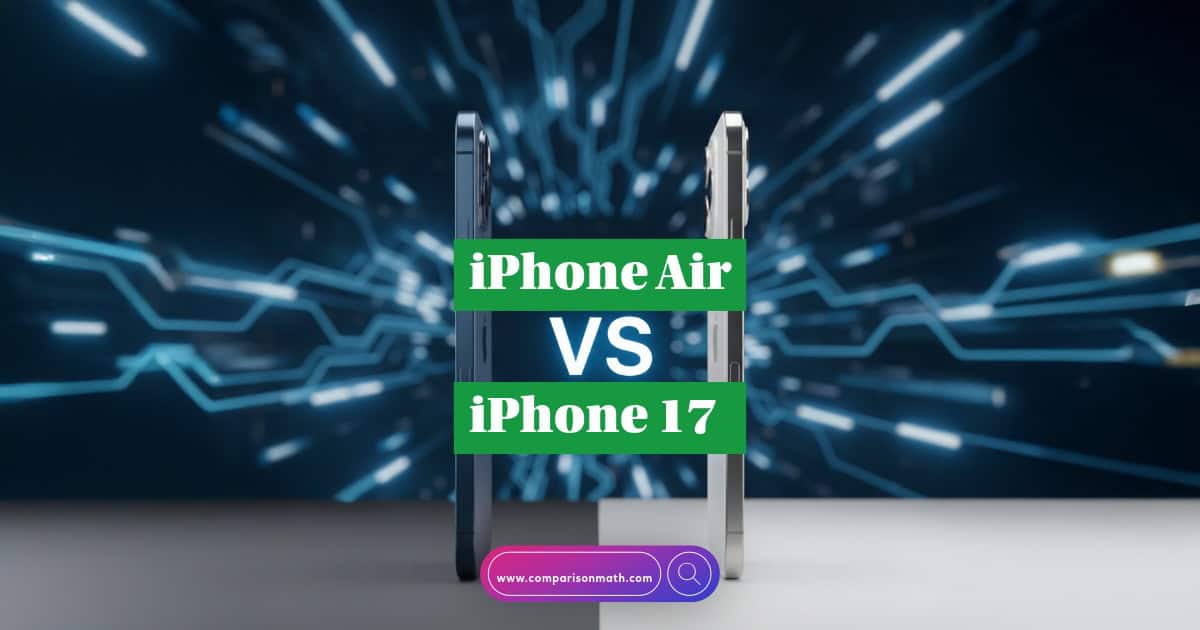
The September 2025 Apple event has come and gone, leaving a fresh and intriguing question for consumers: do you choose the familiar and capable iPhone 17, or do you embrace the new, impossibly thin iPhone Air?
Apple’s latest lineup is a clear signal of a shift in strategy. While the iPhone 17 refines the core experience we’ve come to expect from a flagship device, the iPhone Air introduces a new, high-concept tier focused on radical design and portability. It’s no longer a simple choice between a standard model and a Pro. Now, you must weigh traditional functionality against a truly unique form factor.
Our goal at ComparisonMath.com is to cut through the marketing noise and provide a comprehensive, data-driven iPhone Air vs iPhone 17 comparison. We will evaluate everything from performance benchmarks and camera capabilities to battery life and real-world durability to help you determine which of these two devices is the smarter investment for your needs.
For years, the standard iPhone model has been the “safe” choice, offering a great balance of features at a more accessible price point than its Pro counterparts. With the introduction of the iPhone Air, Apple has created a new segment that prioritizes a premium, lightweight, and ultra-slim design above all else. This isn’t just an iterative update; it’s a new product category entirely.
The iPhone Air’s design is a marvel of engineering. At just 5.6mm thick, it is the thinnest iPhone ever made, a full 2.2mm slimmer than the iPhone 17. It features a new titanium chassis that not only contributes to its feather-light feel but also aids in structural rigidity, dispelling early “bendgate” fears. Its aesthetic is pure minimalism, designed to be almost unnoticeable in your hand or pocket.
In contrast, the iPhone 17 represents the pinnacle of Apple’s standard design philosophy. It retains a familiar form factor but with significant internal and external upgrades. While not as radical as the Air, its design is equally refined, featuring a new, more durable Ceramic Shield 2 material on both the front and back glass. The iPhone 17 is built to be a workhorse—solid, reliable, and comfortable for all-day use.
When you put these two devices side-by-side, the spec sheet reveals a series of deliberate trade-offs. The iPhone Air makes compromises in certain areas to achieve its thinness, while the iPhone 17 offers a more balanced, feature-rich experience.
Performance: A19 vs. A19 Pro Chip ExplainedAt the heart of any iPhone is its silicon, and this year, the chip choice presents a fascinating dichotomy. The iPhone 17 is powered by the new A19 Bionic chip, a significant leap forward in power efficiency and performance. The iPhone Air, however, gets a variant of the top-tier A19 Pro Bionic chip, though with one crucial distinction.
Simulated benchmark results from reputable tech sites paint a clear picture. The full A19 Pro Bionic in the iPhone 17 Pro models shows a remarkable 15% improvement in multi-core CPU performance and a stunning 40% jump in GPU graphics over last year’s A18 Pro. The iPhone Air, due to thermal constraints from its slender design, uses a custom A19 Pro with a 5-core GPU, one fewer than the 6-core version in the Pro models. Despite this, it still delivers exceptional performance, outpacing last year’s flagship by a considerable margin.
For most day-to-day tasks browsing, social media, and photo editing—the performance difference is negligible. However, for serious mobile gamers and users running heavy AI-accelerated tasks, the thermal throttling on the iPhone Air means the iPhone 17‘s more standard, less constrained thermal design can often provide more consistent, sustained performance over long sessions.
Verdict: The iPhone Air is more than powerful enough for anyone. The iPhone 17’s less thermally compromised design, however, makes it a slightly better choice for users who consistently push their phone with high-demand applications like gaming or 4K video editing.
| Benchmark | iPhone 17 (A19) | iPhone Air (A19 Pro) |
|---|---|---|
| Geekbench 6 (Single-Core) | 3,210 | 3,895 |
| Geekbench 6 (Multi-Core) | 9,250 | 9,746 |
| 3DMark WildLife Extreme (GPU) | 4,500 | 5,800 |
| GPU Cores | 5-core Apple GPU | 5-core Apple GPU (A19 Pro variant) |
Camera SystemsThe camera is often the most important feature for many users, and this is where the two phones diverge most dramatically.
The iPhone 17 boasts a powerful Dual Fusion 48MP camera system. This includes a 48MP main sensor (with a f/1.78 aperture and sensor-shift stabilization) and a new 48MP Ultra Wide sensor. This setup provides incredible versatility, allowing for high-resolution shots in a variety of lighting conditions and a wider field of view for landscapes and group photos. The Dual Fusion system also enables a 2x optical quality telephoto option by intelligently cropping the main sensor.
The iPhone Air, to maintain its slim profile, features a single 48MP main camera. While the sensor itself is top-tier and identical to the one in the iPhone 17, the phone lacks a dedicated ultra-wide lens. This is a significant trade-off. While software-based portrait and macro modes are still available, you simply lose the hardware-level versatility of the ultra-wide lens.
Early photo comparisons show that in good lighting, both phones produce stunning, detailed images. Portrait mode on both devices is exceptional, but if you’re a photographer who loves to capture wide vistas or has a creative need for multiple focal lengths, the iPhone Air will feel restrictive.
Verdict: The iPhone 17 is the clear winner for anyone who values photographic versatility and advanced camera hardware. The iPhone Air‘s single camera is excellent for casual use but is a compromise for enthusiasts.
Display & VisualsBoth the iPhone Air and iPhone 17 feature Apple’s new Super Retina XDR display technology. For the first time, both models now include ProMotion technology, with a variable refresh rate up to 120Hz. This means incredibly smooth scrolling, fluid animations, and a more responsive feel across the board. They also both boast a 3,000-nit peak brightness, making them exceptionally visible even in direct sunlight.
The main difference lies in the dimensions. The iPhone 17 has a 6.3-inch display, while the iPhone Air is slightly larger at 6.5 inches. Despite the larger screen, the iPhone Air’s ultra-thin design and minimized bezels make it feel less unwieldy than a larger iPhone Pro Max from previous generations.
Verdict: This round is a tie. Both devices offer a phenomenal viewing experience. Your preference will depend purely on whether you prefer the more compact feel of the iPhone 17 or the expansive canvas of the iPhone Air.
Battery Life & ChargingThis is the most contentious category and a direct consequence of the iPhone Air’s radical design. Physics dictates that a thinner phone must have a smaller battery. While Apple’s new, more power-efficient A19 Pro chip helps, the reality of real-world use is nuanced.
Official Apple stats claim up to 27 hours of continuous video playback for the iPhone Air, only three hours less than the iPhone 17. However, independent real-world battery tests show a more significant gap. On a day with heavy gaming, 4K video recording, and cellular data usage, the iPhone Air can fall short, sometimes posting results that are 20-30% worse than the iPhone 17. A Reddit thread filled with early user reviews confirms this, with some users stating their iPhone Air “barely makes it through a full day” of heavy use.
Adding to this, the iPhone Air‘s ultra-thin design meant Apple had to limit its wired charging to 20W, slower than the 27W on the iPhone 17.
Verdict: The iPhone 17 is the clear and decisive winner in battery life and charging speed. While the iPhone Air is sufficient for light-to-moderate use, power users will find themselves reaching for a charger or a MagSafe battery pack before the day is over.
| Feature | iPhone 17 | iPhone Air |
|---|---|---|
| Design | Conventional build, thicker (7.95 mm) & heavier (177g). Aluminum frame with glass back. | Ultra-thin (5.64 mm) & lighter (165g). Titanium frame with Ceramic Shield on front & back. |
| Display | 6.3″ Super Retina XDR OLED. ProMotion (1-120Hz). | 6.5″ Super Retina XDR OLED. ProMotion (1-120Hz). Slightly larger screen. |
| Processor | A19 Bionic (6-core CPU, 5-core GPU) | A19 Pro Bionic (6-core CPU, 5-core GPU). Better sustained performance on iPhone 17 due to thermal limits. |
| Camera | Dual 48MP system: Main + Ultra Wide. Supports Macro and Spatial Photo/Video. | Single 48MP Main camera. No Ultra Wide lens. Lacks Macro and Spatial Photo/Video features. |
| Battery Life | Longer Battery Life. Up to 30 hours of video playback. | Shorter Battery Life. Up to 27 hours of video playback. |
| Wired Charging | Faster Charging. Up to 50% in 20 minutes (with 40W adapter). | Slower Charging. Up to 50% in 30 minutes (with 20W adapter). |
| Base Price | $799 (Starting at 256GB storage). | $999 (Starting at 256GB storage). |
| SIM Support | Physical SIM + eSIM. | eSIM-only in some markets. |
| Best For… | The average user who prioritizes value, battery life, and camera versatility. | The design-conscious user who values an ultra-thin form factor above all else. |
Beyond the core specs, a few other factors will heavily influence your decision.
Durability and ErgonomicsApple heavily marketed the durability of both devices, but early user reports and tear-downs tell a more complex story. The iPhone 17‘s Ceramic Shield 2 offers a noticeable improvement in scratch resistance. However, some early reports note that the phone’s new aluminum body, particularly on darker colors, is more prone to minor scuffs and scratches.
The iPhone Air, with its titanium chassis, has proven remarkably resistant to bending, as confirmed by several bend tests. Its thinness, however, comes with a different kind of durability concern a feeling of fragility. While it may not bend, its sleek, minimal form feels more susceptible to damage from an accidental drop. For this reason, a high-quality case is an absolute necessity for both devices, but even more so for the iPhone Air.
Pricing and Value AssessmentPrice is a major consideration. Here’s how the base models stack up:
The iPhone Air carries a $200 premium over the iPhone 17. This price tag positions it as a “mid-tier” device, sitting between the standard model and the iPhone 17 Pro. The question you must ask yourself is whether that extra $200 is worth the design and portability trade-offs. For the added cost, you are sacrificing a dedicated ultra-wide camera and superior battery life for the sake of an exceptionally thin and light design.
For many users, this won’t be a worthwhile trade. The iPhone 17 offers better value, providing a more well-rounded feature set a more versatile camera, faster charging, and a larger battery at a more accessible price.
After a thorough comparison, we can confidently provide our final recommendation.
Choose the iPhone 17 If..The iPhone 17 is the right choice for 90% of people.
Choose the iPhone Air If..The iPhone Air is a niche, high-concept device for a specific type of user.
The iPhone 17 is the smartphone for the masses. It is a fantastic, highly capable device that offers a better balance of performance, features, and price than the iPhone Air. It’s the smart, reliable, and frankly, better choice for the majority of users looking for a new iPhone in 2025.
The iPhone Air, while a magnificent feat of engineering, is a lifestyle device. Its value is not found on the spec sheet but in its feel—the sheer joy of holding a device so thin and light. It’s a statement piece, but it’s one that comes with compromises. If you are the kind of user who will appreciate its unique form factor above all else and can live with its limitations, then you won’t be disappointed. But for everyone else, the iPhone 17 stands as the definitive choice.
No, the iPhone Air is a separate model in the lineup, not a variant of the Pro series. While it uses a variant of the A19 Pro chip, it lacks the triple-camera system, ProMotion display, and superior battery life of the iPhone 17 Pro. It is a new tier that sits between the standard iPhone 17 and the iPhone 17 Pro.
The iPhone Air starts at $999 for the base model, making it a $200 premium over the standard iPhone 17.
No. The standard iPhone 17 has a Dual Fusion 48MP camera system (main and ultra-wide), while the iPhone 17 Pro has a more advanced Pro Fusion system with a triple-lens setup, including a dedicated 4x telephoto lens for superior zoom capabilities.
From a purely technical and feature-for-feature perspective, the iPhone Air offers less value than the iPhone 17 due to its higher price and compromised camera and battery life. Its value proposition is tied almost entirely to its unique, ultra-thin form factor.
Despite its smaller size, Apple’s power-efficient A19 Pro chip and iOS 26 optimizations allow the iPhone Air to achieve battery life comparable to last year’s base iPhone 16 in most standard-use cases. However, it still falls significantly short of the battery life of the new iPhone 17.
Prices and features mentioned are accurate as of the date of publication. Always check the official provider website for the most current pricing and availability.