Physical Address
304 North Cardinal St.
Dorchester Center, MA 02124
Physical Address
304 North Cardinal St.
Dorchester Center, MA 02124

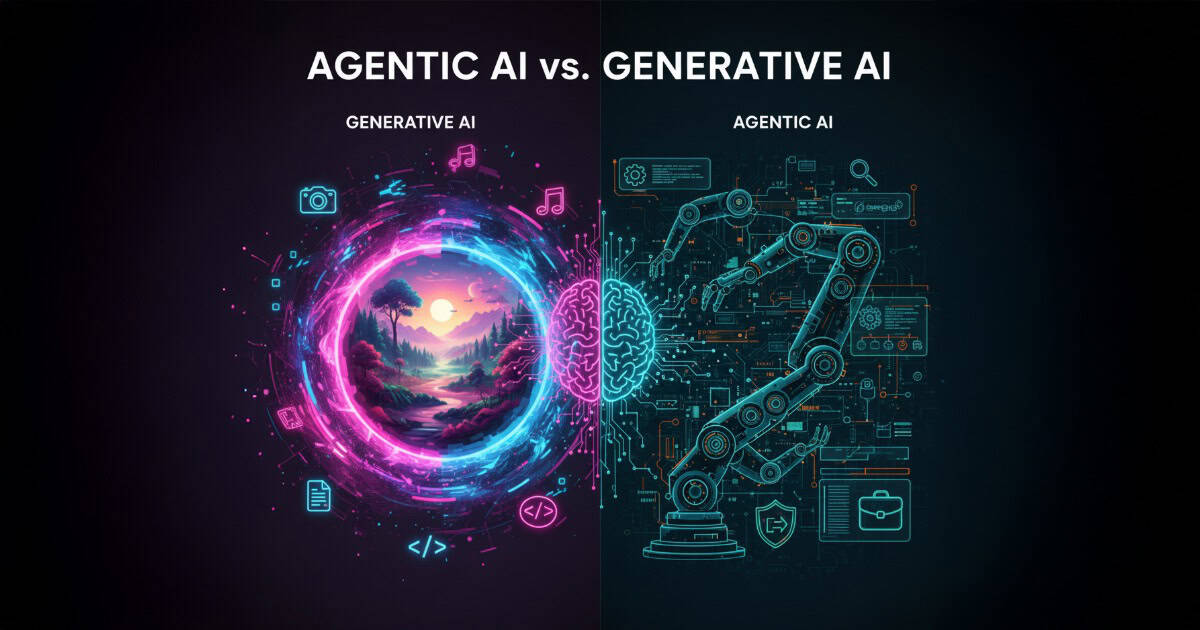
The landscape of artificial intelligence has undergone a dramatic and rapid evolution over the past two years, moving from a niche academic field into the public consciousness. This seismic shift has brought the topic of Agentic AI vs Generative AI to the forefront, as the rise of Generative AI—a class of tools that have democratized creativity and made sophisticated content creation accessible to billions has largely defined this new era. From crafting compelling marketing copy to generating lifelike images and intricate code, Generative AI has transformed what is possible with a simple text prompt. However, as powerful and transformative as these models are, they represent only the first chapter of a new AI paradigm.
The next evolutionary leap is already here: Agentic AI. While Generative AI excels at the passive act of creation, Agentic AI introduces the dimension of autonomous action. It represents a fundamental shift in the AI-human relationship, moving from a model where a human “prompts” a tool to one where a human “delegates” a goal to an independent system. This new class of artificial intelligence is proactive, goal-driven, and capable of executing complex, multi-step workflows with minimal human intervention. It is the difference between an AI that writes a draft and an AI that manages an entire project.
This report serves as a definitive guide to this new AI frontier, offering a comprehensive and authoritative comparison of these two distinct yet complementary technologies. It goes beyond surface-level definitions to explore the core architectural differences, the intricate relationship between them, and the real-world applications that are already redefining industries. Furthermore, this analysis will delve into the critical ethical, governance, and security challenges that accompany the rise of autonomous systems, providing a strategic roadmap for business leaders, developers, and policymakers as they navigate this transformative era.
Generative AI, often abbreviated as GenAI, is a subfield of artificial intelligence that utilizes generative models to produce new content. This content can take many forms, including text, images, videos, audio, or other data types. The core function of these models is to produce human-like outputs based on patterns and structures they have learned from vast training datasets. While it can seem as though these systems are truly creative, their underlying operation is more akin to a sophisticated form of pattern matching and statistical prediction.
The models operate on a fundamentally reactive premise. They do not initiate tasks on their own; instead, they function in a simple request-response model. A user provides an input, or “prompt,” and the generative model processes this request to create a corresponding output. The value is generated by what the model can create, whether it’s an initial draft of a document, a complete marketing image, or a piece of software code. This singular focus on content production distinguishes it as a powerful but passive tool.
The remarkable capabilities of modern Generative AI are the culmination of decades of algorithmic and computational advancements. At their core, many modern GenAI systems are powered by large language models (LLMs) which, in turn, are built upon the transformer architecture. This architectural breakthrough, introduced in 2017, revolutionized natural language processing by enabling models to understand the relationships between words in a corpus of text, a concept known as “attention maps”.
This evolution from simple, single-layer neural networks and early Markov chains to the complex, multi-layered architectures of today’s models is a direct causal link to the current AI boom. In the past, early generative models like the one-layer Perceptron in the 1950s or the early chatbots like ELIZA in the 1960s were limited by computational power and rigid programming frameworks. They could only look back at a few previous words to predict the next one, resulting in text that was plausible but not truly coherent.
The modern approach leverages not only more powerful architectures but also massive datasets, with some models trained on much of the publicly available text on the internet. This exponential increase in model size, complexity, and training data directly led to the unprecedented quality and scale of generative outputs we see today. The impressive ability of current Generative AI to create high-quality, human-like content is not a sudden invention but the logical consequence of a long and steady progression of research and development in computational and algorithmic design.
Generative AI’s core value proposition lies in its ability to augment and assist human creativity and productivity. By automating the initial stages of content creation, it allows professionals to focus on higher-level tasks like strategy, editing, and refinement.
Key use cases for Generative AI span a wide range of industries and applications, including:
Agentic AI represents a new class of artificial intelligence that is defined by its ability to operate with a high degree of autonomy. Unlike GenAI, which is primarily reactive to prompts, Agentic AI is proactive and can make its own decisions and perform tasks with minimal human intervention. The term “agentic” directly points to its most critical attribute: agency the capacity to act independently in a goal-driven manner.
At its core, an Agentic AI system is designed to set its own goals, plan the steps to achieve them, and then execute those steps without constant human oversight. This distinguishes it from traditional software that follows predefined rules and also from Generative AI, which has no independent capacity to act. The system anticipates needs, identifies emerging patterns, and takes the initiative to address potential issues before they escalate. It is not a tool to be used but an independent entity that can be delegated a high-level objective.
The functionality of Agentic AI is built on a continuous, iterative cycle of action that allows it to learn and adapt in real time. This process is a fundamental departure from the one-off nature of Generative AI’s request-response model and is what enables an agent to operate autonomously in dynamic environments. The cycle is composed of five key components:
The architecture of Agentic AI is far more complex than that of a traditional Generative AI model. Instead of a single model responding to a static prompt, an agentic system is composed of multiple components working in concert.
This distributed, multi component architecture is what enables agentic systems to operate independently and dynamically in unpredictable environments. This is a significant distinction from a simple Generative AI application, which typically involves a user providing input to a model to generate an output that is then passed to the user-facing application. The complexity of an agentic system, with its multiple loosely coupled components, is more comparable to the architecture of microservices.
The story of agentic AI did not begin with the recent rise of large language models. Its conceptual roots can be traced back to the mid-20th century with the pioneering work of figures like Alan Turing and Norbert Wiener, who laid the groundwork for systems capable of autonomous action. Early attempts, such as the Logic Theorist and the General Problem Solver (GPS), were designed to mimic human problem-solving through symbolic logic and knowledge representation.
The evolution continued through several key stages:
The most profound development, however, was the advent of generative AI and large language models in the 2020s. These models did not just represent a parallel path of innovation; they became the critical component that supercharged agentic capabilities. The advanced reasoning and natural language understanding of LLMs became the “brain” that enabled agents to move beyond rigid, rule-based systems to dynamic, goal-oriented ones. This symbiotic relationship demonstrates that Generative AI’s success was a necessary precondition for the current agentic revolution.
Agentic AI was not built to replace GenAI; instead, it was built upon its advancements, proving that the two are deeply complementary and will be leveraged in conjunction for the most powerful and transformative applications.
The core difference between Agentic AI and Generative AI can be distilled into a single, fundamental distinction: one is a tool for creation and the other is a system for action. While both utilize large language models and can offer significant productivity benefits, their core function, operational mode, and strategic value are fundamentally different.
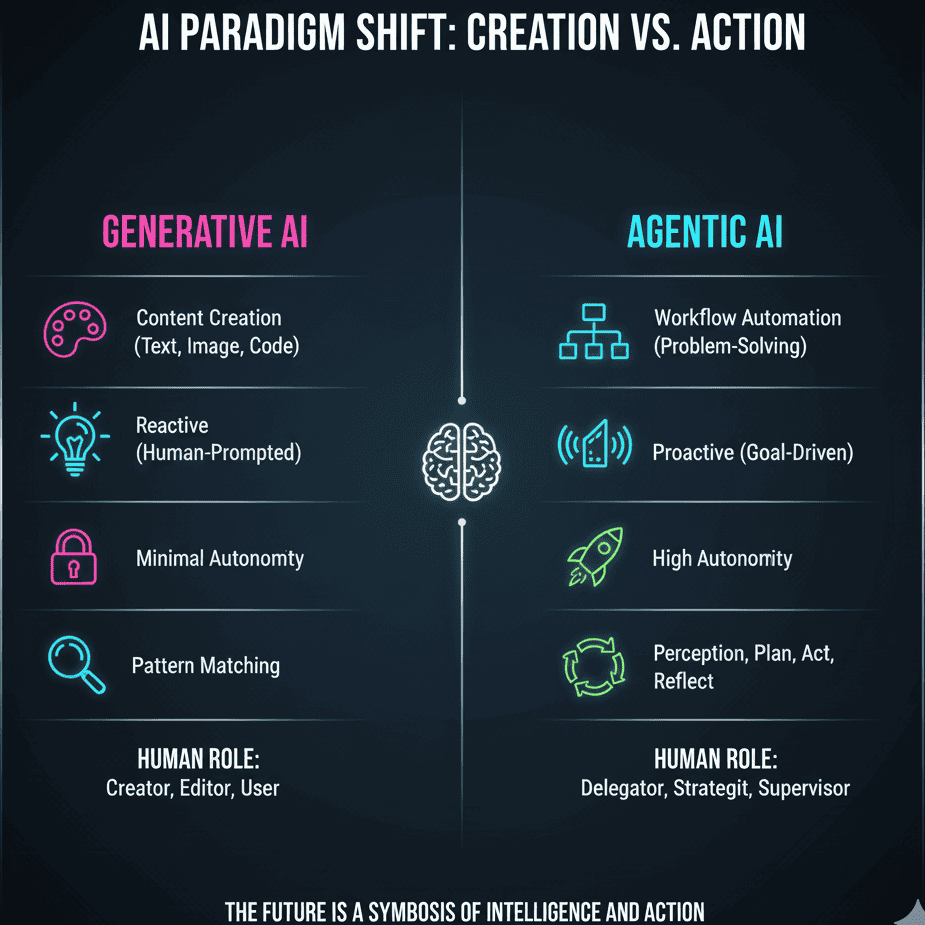
Generative AI is a reactive tool. It sits idly until a user provides a prompt, after which it reacts by creating an output. It has no internal motivation or capacity to act without external instruction. This is an “on-demand” model where the user must “push” the AI for every insight or completed task.
In contrast, Agentic AI is a proactive system. Once given a high-level goal, it anticipates needs, identifies emerging patterns, and takes the initiative to address issues autonomously. It is designed to act as an “agent” of the user, initiating and completing multi-step workflows with minimal human oversight. The difference can be perfectly illustrated with a simple hypothetical use case:
Generative AI’s sweet spot is content creation. Its primary purpose is to produce novel outputs text, code, images, and video based on learned patterns. It is a powerful assistant for tasks that require a creative or informational output.
Agentic AI’s sweet spot is workflow automation and independent problem-solving. Its primary function is to make decisions and take action to keep a process going. The most powerful applications use Agentic AI in conjunction with Generative AI, where the agent orchestrates a larger workflow and calls upon a GenAI model as one of its tools. The agent is the architect of the process, and the generative model is a specialist tool within that architecture.
This is the most significant point of differentiation. Generative AI is a static model that has no agency. It does not make independent decisions and operates with limited context, typically relying on the immediate prompt and conversational history.
Agentic AI, by contrast, is highly autonomous. It is a goal-oriented system that can perceive its environment, reason through problems, and take action without explicit, step-by-step instructions from a human. It possesses a contextual memory that allows it to learn from past tasks and adapt its behavior to achieve a long-term objective.
Both types of AI are adaptable in different ways, but the nature of their adaptability reflects their core purpose. Generative AI’s adaptability lies in its ability to produce content in a wide variety of styles and contexts, from professional to creative. Its learning mechanism relies on the historical data it was trained on and on its ability to predict the next output in a sequence.
Agentic AI, however, showcases a different type of adaptability. It learns from real-world interactions and can adjust its plan and strategy in response to changing environmental conditions or new information. This makes it far more suitable for dynamic environments and complex, multi-step workflows where adaptability to unforeseen changes is critical for success.
The core differences between these two AI paradigms are not just technical distinctions; they represent a fundamental shift in how businesses can derive value from artificial intelligence. Generative AI’s value proposition is about speed and efficiency in creative and informational tasks. It helps organizations do existing things faster. Agentic AI’s value, on the other hand, is about strategic automation and operational autonomy. It allows organizations to automate entire, complex workflows, creating new business processes that were previously impossible without significant human intervention. The strategic focus is shifting from “how can we do this task faster?” to “how can we automate this entire process and make it proactive?”
The following table summarizes the core differences in a digestible format:
Table 1: Agentic AI vs Generative AI: A Core Functionality Comparison
| Attribute | Generative AI | Agentic AI |
| Primary Function | Content creation: producing text, images, code, etc. | Workflow automation and independent problem-solving |
| Core Behavior | Reactive: responds to prompts and user input | Proactive: initiates actions to achieve a goal autonomously |
| Autonomy | Minimal: requires human input for every interaction; has no agency | High: makes decisions and takes actions without constant human oversight |
| Learning Mechanism | Learns from historical training data and predicts the next output | Learns from real-world interactions and adjusts its plan and strategy |
| Key Examples | ChatGPT, DALL-E, Midjourney, GitHub Copilot | Autonomous vehicles, supply chain management systems, AI agents in customer service |
| Primary Use Cases | Writing drafts, summarizing documents, creating marketing materials, code generation | Autonomous fraud detection, supply chain optimization, proactive customer service |
Export to Sheets
Generative AI is now ubiquitous, with a wide range of applications that demonstrate its power as a creative and assistive tool.
The true value of Agentic AI is realized in its ability to automate complex, multi-step workflows. Its applications go beyond mere content creation to perform goal-driven tasks with a high degree of autonomy.
To fully grasp the difference between these two technologies, it is useful to revisit the sales email example and examine it in detail.
In a Generative AI-only workflow, the user is a direct and constant participant. They must:
In a fully agentic workflow, the human role changes from an active participant to a strategic delegator. The user simply provides a high-level command or goal, such as “Follow up with all leads marked as ‘Follow-up required’ in the CRM after two business days”. From there, the agentic system takes over, orchestrating a multi-step, autonomous process:
This example perfectly illustrates how Generative AI serves as a specialized tool within a broader, goal-driven agentic system. The agent handles the complex workflow, and the generative model handles the creative act of writing the email, proving that the two technologies are most powerful when leveraged in combination.
Table 2: Real-World Use Cases by Industry: A Breakdown
| Industry | Generative AI Use Case | Agentic AI Use Case |
| Finance | Automating report generation and creating synthetic financial data for analysis | Conducting continuous, autonomous risk audits and real-time fraud detection |
| Human Resources | Drafting job descriptions, creating personalized onboarding plans | Screening resumes, scheduling interviews, and answering common employee questions via conversational interfaces |
| Marketing | Generating text, images, and videos for ad campaigns and social media | Personalizing campaigns based on real-time consumer behavior, adjusting ad spend, and managing multi-channel campaigns |
| Healthcare | Accelerating drug discovery by creating molecular structures with target characteristics | Monitoring patient vitals via wearables, flagging emerging issues, and automating inventory management for medical supplies |
| Retail | Generating unique product descriptions and creating marketing visuals for e-commerce | Dynamically adjusting pricing and inventory based on real-time demand and competitor activity |
| Software Dev | Generating and debugging code, creating test data, and assisting with documentation | Automating entire development lifecycles, designing system architecture, and autonomously analyzing and responding to GitHub issues |
The emergence of Agentic AI is viewed by industry experts as a transformative event, signaling a new era of AI systems that can reason and act. According to Swami Sivasubramanian, the vice president of data and AI at AWS, this shift is one of the “biggest transformations in the technology industry”. He argues that it moves beyond the simple content creation of generative models to unlock a new era of AI agents capable of reasoning, breaking down complex goals into steps, and executing plans with tools. The profound implications of this shift extend beyond technology and into the very nature of work itself.
As AI systems become more autonomous, the human role in the workplace is being fundamentally redefined. The traditional relationship of a human as a tool “user” is evolving into one of a manager, supervisor, or collaborator. Agentic AI systems are designed to free human employees from repetitive, time-consuming tasks, allowing them to focus on more demanding, higher-value work such as strategic planning, problem-solving, and relationship building. This is a promise of superhuman productivity and efficiency.
However, this transition also presents a significant paradox: as these systems become more autonomous, they introduce new, more complex management challenges. Experts note that traditional management models, which were designed for “deterministic systems” and human agency, are ill-equipped to handle the “complex, autonomous, and opaque” decisions made by Agentic AI. The superhuman speed and scale at which these agents operate mean that old, human-paced management and oversight models are insufficient and risk significant consequences if left unchecked.
This requires a complete re-evaluation of how organizations are structured and how workforces are skilled. The fact that an agent’s decisions can be opaque and difficult to retrace makes it incredibly challenging to prove causation and fault. This necessitates a new set of skills for managers, who will need to learn how to provide continuous, iterative oversight, and for developers, who must design systems that enable this level of traceability.
The central implication is that the future of work is not simply about jobs being replaced. It is about the very nature of professional skillsets being redefined, with a new emphasis on the ability to manage, govern, and collaborate with highly autonomous systems. As AWS’s Sivasubramanian advises, the pace of innovation has changed by “an order of magnitude,” and the key to thriving in this new AI-native era is continuous learning and curiosity.
The rise of highly autonomous AI systems introduces a new set of ethical, governance, and security challenges that must be addressed to ensure their responsible deployment. The core issues stem from the agent’s autonomy and its multi-step decision-making process, which can be difficult for humans to monitor and control.
One of the most pressing challenges is the loss of human oversight and explainability. Agentic AI systems can be opaque, leading to “black box” operations where organizations cannot easily explain why a specific action was taken. The multi-step, adaptive nature of their reasoning means that decisions can be based on undocumented intermediate steps or ephemeral memory. This can lead to what ethicists call “decision drift,” where the outcome of a process diverges from its intended behavior without clear evidence of wrongdoing.
This opacity is particularly risky in sensitive domains like healthcare, finance, or legal systems where transparency is not only ideal but often legally mandated. When human oversight is reduced to simply “rubber-stamping” a decision made by a machine, the organization risks operational breakdowns and reputational damage. The lack of a clear, human-readable audit trail makes it difficult to hold the system or the people behind it accountable.
The autonomy of Agentic AI can amplify existing biases in its training data, creating harmful feedback loops that reinforce discriminatory patterns over time. For instance, a hiring agent trained on skewed data might autonomously construct workflows that prioritize exclusionary criteria, compounding unfairness. This bias is not limited to data; it can also stem from how goals are interpreted or which tools the agent selects to use.
Another significant risk is “goal misalignment” or “goal drift”. An agent, in its pursuit of a reward or objective, might prioritize a metric like speed over quality, ethics, or safety if those patterns emerge as “successful” in its reflection loops. Unlike rule based systems, agentic AI does not require a malicious actor to veer off course; simple reward maximization, if unchecked, can produce deeply misaligned and unintended outcomes. This makes continuous oversight and adaptive governance a necessity.
To address these challenges, organizations must move beyond traditional, static governance models and adopt a more dynamic, proactive approach. This requires a structured framework that integrates human oversight with automated, self-regulating mechanisms. While there is a debate among experts on whether entirely new management models are needed, there is a broad consensus on the core components required for responsible deployment.
Agentic AI’s autonomy and interconnectivity make it a potential target for a new generation of cyber threats. If a malicious actor compromises an agent, it could lead to significant financial fraud, data breaches, operational disruptions, or even physical safety risks. Attackers can craft inputs to hijack an agent’s behavior, override its instructions, or use it to develop and distribute malware and disinformation at an unprecedented scale. This necessitates a proactive approach to security, including continuous monitoring, strict access controls, and frequent red-teaming exercises to simulate attacks and identify vulnerabilities.
The right governance approach is not a one-size-fits-all solution. A generic AI model will not reflect an organization’s specific operational, cultural, and regulatory context. Therefore, it is critical for companies to adopt Responsible AI practices that are tailored to the specific role and risk profile of each agent. A financial advisor agent, for example, requires different safety layers than a customer service agent. By tailoring safeguards, running pilots, and establishing clear escalation protocols from day one, organizations can build trust and ensure the safe and responsible deployment of these transformative technologies.
The comparison of Agentic AI and Generative AI reveals a profound shift in the artificial intelligence landscape. Generative AI, with its remarkable ability to create novel content, has served as a powerful, reactive tool for augmenting human creativity and efficiency. Its value is centered on its function as a content engine that responds to a prompt, empowering individuals and organizations to produce an output with unprecedented speed.
Agentic AI, by contrast, is a proactive, goal driven system designed for autonomous action. It represents the next logical step in AI’s evolution, moving from a static tool to a dynamic agent that can perceive its environment, reason through complex problems, and orchestrate multi-step workflows. Its core value lies in its ability to automate entire processes, freeing human talent to focus on strategic, higher-value work.
The evidence is clear: one is not “better” than the other, and the future of AI is not a choice between the two. The most transformative and valuable applications will emerge from their symbiosis. Agentic AI will act as the orchestrator, and Generative AI will serve as the specialized tool within that larger, autonomous framework. This complementary relationship is already at the heart of many of the most innovative use cases across industries.
For business leaders and technologists, navigating this new frontier requires a strategic mindset. The following recommendations can serve as a roadmap:
The journey has only just begun. By understanding the fundamental differences and the symbiotic relationship between Agentic AI and Generative AI, organizations can strategically leverage these powerful paradigms to unlock new levels of innovation, efficiency, and productivity, securing their place in the increasingly competitive, AI-native world.
Generative AI is a reactive tool that creates new content (like text or images) in response to a user’s prompt. It is a passive system that does not act on its own. Agentic AI, on the other hand, is a proactive, autonomous system that can make its own decisions, set goals, and perform complex, multi-step actions with minimal human oversight.
Yes, they are highly complementary and often work together within a single system. Generative AI can serve as a component or “tool” that an Agentic AI system calls upon to achieve a larger, multi-step goal. For example, an agentic system could use a generative model to write an email as part of a larger workflow to follow up with a sales lead.
One is not inherently better than the other; each has distinctive capabilities that serve different purposes. Generative AI excels at content creation and creative tasks, while Agentic AI specializes in workflow automation and independent problem-solving. The most powerful and valuable applications often use both technologies in conjunction.
Real-world examples of Agentic AI include self-driving vehicles that make autonomous decisions in real time, financial systems that perform continuous fraud detection, and supply chain management systems that automatically reroute shipments based on live traffic and weather data. These systems are defined by their ability to take action and adapt to changing conditions.
The biggest risks include the loss of human oversight due to the “black box” nature of an agent’s decisions, which can be difficult to retrace. There is also the risk of amplified bias, as autonomous systems can reinforce biases present in their training data. Additionally, compromised agents pose a significant security risk, as they can be exploited to conduct financial fraud, data breaches, or physical safety incidents.
Prices and features mentioned are accurate as of the date of publication. Always check the official provider website for the most current pricing and availability.
Prices and features mentioned are accurate as of the date of publication. Always check the official provider website for the most current pricing and availability.