Physical Address
304 North Cardinal St.
Dorchester Center, MA 02124
Physical Address
304 North Cardinal St.
Dorchester Center, MA 02124

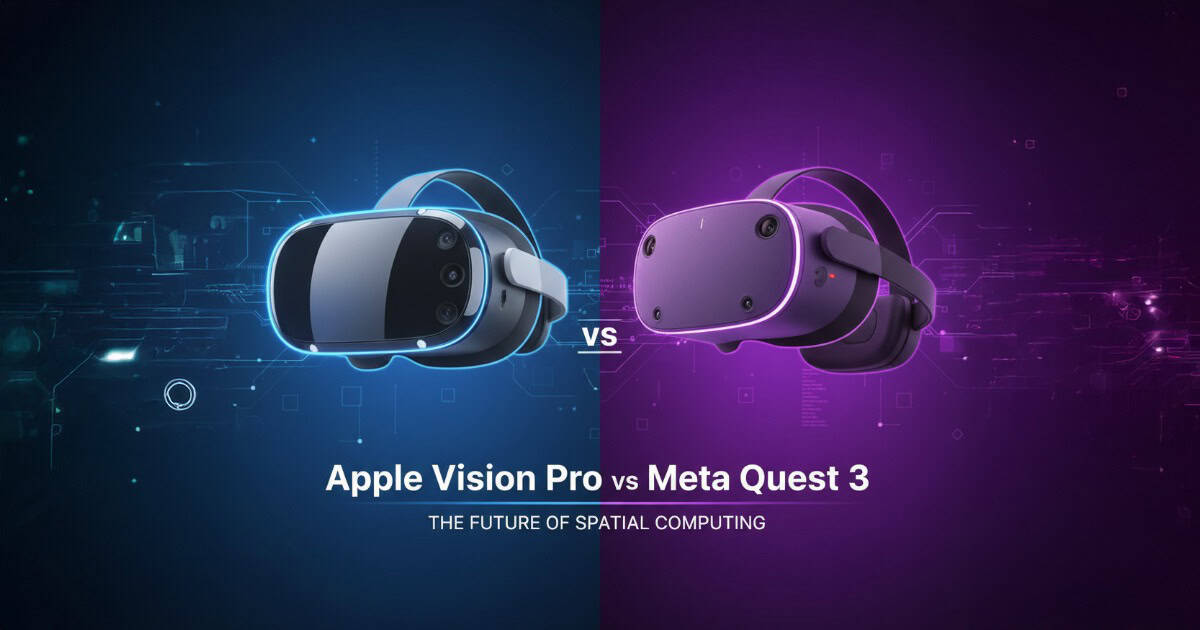
The Definitive 2025 Interactive Comparison & FAQ
This section provides a high-level snapshot of the most critical specifications. Use this for a quick understanding of where each headset stands before diving into the detailed comparisons.
Price
$3,499+
Resolution Per Eye
~3660 x 3200 (23M pixels total)
Primary Processors
Apple M2 + R1 Chip
Core Focus
Spatial Computing & Productivity
Price
$499+
Resolution Per Eye
2064 x 2208
Primary Processor
Snapdragon XR2 Gen 2
Core Focus
Mixed Reality Gaming & Social
Dive deep into the hardware that powers these devices. Select a category below to compare the technical specifications side-by-side and understand the engineering choices behind each headset.
Which headset is right for your needs? Select a use case to see how the Vision Pro and Quest 3 stack up, with analysis on their strengths and weaknesses for each activity.
The sticker price is just the beginning. Use the interactive chart below to compare the base price and see how the total cost of ownership changes when you add essential or popular accessories.
This final section synthesizes all the data to provide clear recommendations. Your choice depends entirely on your budget, your existing tech ecosystem, and what you hope to achieve with mixed reality.
Winner: Meta Quest 3 It’s not even a contest. The Quest 3 is built from the ground up for gaming, boasting a massive and mature library of VR titles, backward compatibility, and developer focus on interactive entertainment. The lower price point makes it accessible, and the Touch Plus controllers provide the tactile feedback essential for immersive gaming.
Winner: Apple Vision Pro. If you’re already invested in the Apple ecosystem, the Vision Pro is a productivity powerhouse. Its seamless integration with macOS, iOS, and iCloud, combined with an ultra-high-resolution display for crisp text, makes it a viable monitor replacement and a futuristic multitasking tool. The hand-and-eye tracking is revolutionary for navigating UIs, though less so for gaming.
Winner: Meta Quest 3. At a fraction of the cost, the Quest 3 offers a fantastic entry point into high-quality mixed reality. Its passthrough is significantly improved over the Quest 2, and it provides a compelling blend of VR and MR experiences without requiring a five-figure investment. It’s the best value-for-money proposition in the XR market today.
Have more questions? We’ve compiled answers to the most common queries about the Vision Pro and Quest 3 to help you make an informed decision.
The biggest difference is the target audience and price. The Apple Vision Pro ($3499+) is a premium “spatial computer” for productivity and media, deeply integrated with the Apple ecosystem. The Meta Quest 3 ($499+) is a mass-market mixed reality headset focused on gaming and social experiences.
No. While they share the “mixed reality” concept, their underlying technology is vastly different. The Vision Pro uses far more advanced (and expensive) components, like micro-OLED displays with 23 million pixels, a laptop-grade M2 processor, and a dedicated R1 chip for sensor processing. This results in a significantly higher fidelity experience, particularly in visual clarity and passthrough quality.
For beginners, the Meta Quest 3 is the clear choice. It’s more affordable, easier to set up, and has a massive library of games and apps that are simple to get into. The Vision Pro is a more complex device aimed at professionals and developers at this stage.
Passthrough is the ability to see the real world through the headset’s cameras. The Apple Vision Pro does it significantly better. Its passthrough is high-resolution and has extremely low latency (12ms), making the real world look crisp and feel almost natural. The Quest 3’s passthrough is a huge improvement over Quest 2 but is still grainier and less realistic than the Vision Pro’s.
No, the Meta Quest 3 does not have eye tracking. The Apple Vision Pro uses eye tracking as a primary input method, allowing you to select items just by looking at them. This also enables “foveated rendering,” a technique where the device only renders what you’re looking at in full detail, saving processing power.
To reduce the weight on the user’s head. The powerful M2 and R1 chips, along with the high-resolution displays, consume a lot of power. Integrating a battery large enough for a 2-hour runtime would have made the headset uncomfortably heavy. The external pack is a trade-off for comfort and performance.
You can play SteamVR games on the Meta Quest 3 via a PC connection using Quest Link (wired) or Air Link (wireless). The experience is very good. The Apple Vision Pro does not officially support SteamVR. While some third-party solutions are in development, it is not a primary function and is not guaranteed to work well.
For some users, yes. Its ultra-high resolution makes text incredibly sharp and readable, unlike older headsets. The ability to create a massive, multi-window workspace that integrates with your Mac makes it a powerful productivity tool. However, the 2-hour battery life and current weight/comfort may be limiting factors for a full 8-hour workday.
The Apple Vision Pro offers a superior movie-watching experience. Its micro-OLED display provides perfect blacks and vibrant colors, similar to a high-end OLED TV. Combined with its high resolution and spatial audio, it can create a truly cinematic personal theater. The Quest 3 is still good for media, but its LCD screen can’t match the contrast and color of the Vision Pro.
Prices and features mentioned are accurate as of the date of publication. Always check the official provider website for the most current pricing and availability.




