Physical Address
304 North Cardinal St.
Dorchester Center, MA 02124
Physical Address
304 North Cardinal St.
Dorchester Center, MA 02124

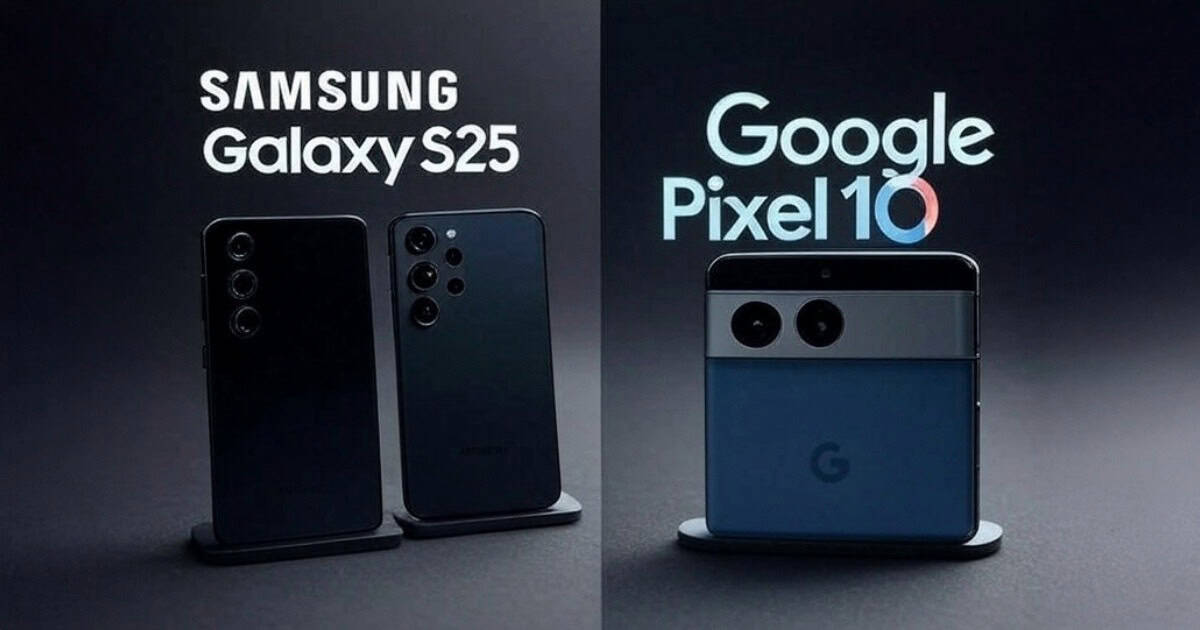
In the dynamic landscape of 2025 smartphones, the demand for compact Android phones has surged, with users seeking devices that balance portability, power, and premium features without the bulk of larger models. Enter the Samsung Galaxy S25 and Google Pixel 10—two flagship contenders that epitomize this trend. Launched in January 2025, the Samsung Galaxy S25 builds on Samsung’s reputation for hardware excellence, introducing refined AI capabilities and robust performance tailored for multitaskers and creators.
On the flip side, the Google Pixel 10, released in August 2025, leverages Google’s software mastery to deliver an unparalleled user experience, particularly in photography and AI-driven tasks. This Samsung Galaxy S25 vs Google Pixel 10 comparison delves deep into their specs, real-world performance, and value to help you decide which compact flagship reigns supreme.
If you’re pondering questions like “Should I buy Galaxy S25 or wait for Pixel 10 in 2025?” or exploring Samsung S25 vs Pixel 10 specs, this guide provides a thorough breakdown. Drawing from hands-on reviews by tech experts at sites like GSMArena, Android Authority, and CNET, along with user feedback from forums such as Reddit and XDA Developers, we’ll analyze every facet. Ultimately, we’ll declare a winner based on objective criteria, ensuring our verdict ties directly to the evidence presented.
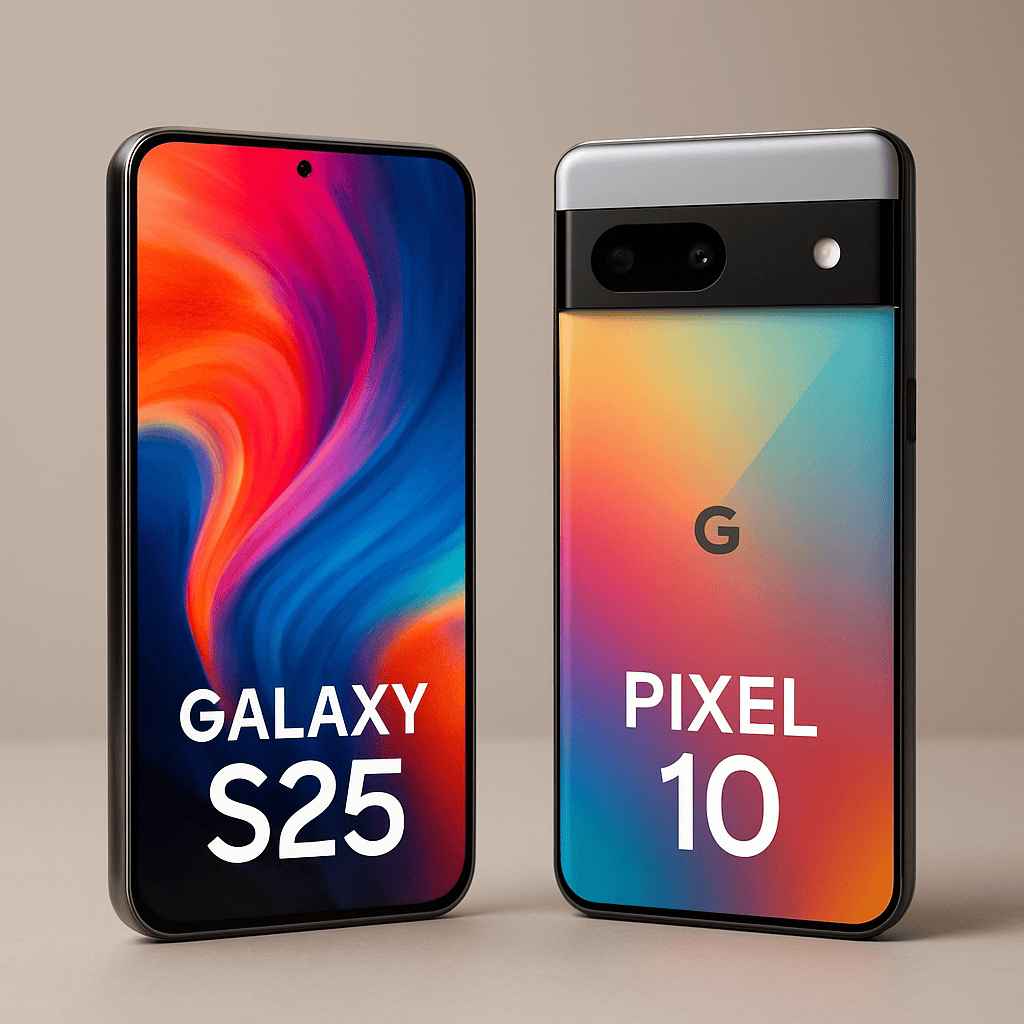
Design plays a pivotal role in the appeal of compact Android phones in 2025, where ergonomics and durability determine daily usability. The Samsung Galaxy S25 measures 146.3 x 70.6 x 7.6mm and tips the scales at 167g, making it one of the lightest flagships in its class. Its build incorporates a reinforced aluminum frame sandwiched between Gorilla Glass Victus 2 panels, offering enhanced scratch resistance and a premium tactile feel.
Available in vibrant hues like Amber Yellow, Cobalt Violet, Moonlight Blue, and Silver Shadow, the phone’s flat edges and matte finish reduce fingerprints and improve grip, ideal for one-handed operation. With an IP68 rating, it can withstand submersion in 1.5 meters of water for 30 minutes, and Samsung has integrated recycled materials, aligning with eco-conscious trends—about 25% of the device uses post-consumer recycled content.
Comparatively, the Google Pixel 10 is slightly more petite at 143.6 x 69.5 x 8.5mm and 175g, emphasizing a curvaceous design that feels more natural in the palm. It features an aerospace-grade aluminum alloy frame with a Gorilla Glass Victus front and a soft-touch matte glass back, available in colors such as Peony, Porcelain, Obsidian, and Wintergreen.
The iconic camera bar not only serves as a design signature but also aids in stability when placed on flat surfaces. Like Samsung, it carries an IP68 rating, but Google adds extra flair with 100% recycled aluminum in the frame, pushing sustainability further. In drop tests conducted by YouTubers like JerryRigEverything, both phones hold up well, but the Pixel’s thicker profile provides marginally better impact absorption.
Display quality further differentiates them. The Galaxy S25 boasts a 6.2-inch Dynamic AMOLED 2X panel with a 2340 x 1080 resolution, supporting a variable 1-120Hz refresh rate for buttery-smooth animations and energy efficiency. Its peak brightness reaches 2,600 nits, ensuring legibility in direct sunlight, and features like Vision Booster enhance color vibrancy in HDR content. In contrast, the Pixel 10‘s 6.1-inch Actua OLED display offers a 2424 x 1080 resolution with the same 120Hz refresh, but its 2,700 nits peak brightness and superior color calibration (Delta E <1) make it a favorite for media consumption.
Google’s display includes adaptive color modes that adjust based on ambient light, reducing eye strain during prolonged use. Based on DisplayMate tests, Samsung’s screen excels in outdoor scenarios, while Google’s is better for accurate photo editing. If you value a larger, more immersive screen for gaming, the Galaxy S25 wins; for compact precision and comfort, the Pixel 10 takes the lead.
Performance is where the Galaxy S25 vs Pixel 10 rivalry intensifies, as each phone targets different user priorities. The Samsung Galaxy S25 is equipped with the Qualcomm Snapdragon 8 Gen 4 processor (or Exynos 2500 in select regions), a 3nm chip that delivers exceptional efficiency and power. Paired with 12GB of LPDDR5X RAM and UFS 4.0 storage options ranging from 128GB to 512GB (expandable via cloud but no microSD slot), it achieves Geekbench 6 scores of approximately 2,300 single-core and 7,500 multi-core. In real-world scenarios, this translates to seamless multitasking—running multiple apps like Adobe Lightroom, Spotify, and Chrome without lag.
Gaming performance is stellar; it handles demanding titles such as Call of Duty Mobile or PUBG at ultra settings with frame rates consistently above 60fps, aided by a large vapor chamber cooling system that keeps thermals below 45°C even after 30 minutes of intensive use. Samsung’s Game Booster optimizes GPU allocation, reducing battery drain by up to 20% during sessions.
The Google Pixel 10, powered by the custom Tensor G5 chip (also 3nm), focuses on AI acceleration rather than brute force. With 12GB RAM and identical storage tiers, its Geekbench scores are lower at around 1,800 single-core and 4,500 multi-core, but it excels in machine learning tasks. For instance, on-device AI processing for features like real-time translation in Google Translate is 25% faster than on Snapdragon devices, per Google’s benchmarks.
Gaming is competent, maintaining 50-60fps in Genshin Impact, but it can throttle after 20 minutes, reaching 48°C without advanced cooling. The Tensor G5’s integration with Google’s services allows for smoother ecosystem experiences, such as instant photo backups to Google Photos or quick pairing with Chromebooks.
Both support sub-6GHz and mmWave 5G, Wi-Fi 7 for speeds up to 5.8Gbps, and Bluetooth 5.4. Samsung adds UWB for precise location tracking with Galaxy ecosystem devices, while Google emphasizes seamless connectivity with Android Auto and Wear OS watches. In AnTuTu benchmarks, the Galaxy S25 scores over 1.8 million, outpacing the Pixel 10‘s 1.2 million. For power users editing 4K videos or running emulators, Samsung dominates; for AI-centric tasks like voice-to-text or smart replies, Google shines. Expert reviews from Tom’s Guide note that while Samsung offers “unmatched raw power,” the Pixel’s optimizations make it feel snappier in everyday use.
| Feature | Samsung Galaxy S25 | Google Pixel 10 |
|---|---|---|
| Processor | Snapdragon 8 Gen 4 / Exynos 2500 | Tensor G5 |
| RAM/Storage | 12GB LPDDR5X / 128-512GB UFS 4.0 | 12GB / 128-512GB |
| Geekbench Multi-Core | ~7,500 | ~4,500 |
| AnTuTu Score | ~1,800,000 | ~1,200,000 |
| Cooling System | Advanced Vapor Chamber | Standard Thermal Management |
| Unique Feature | UWB Support | AI-Optimized Chip |
The Pixel 10 camera vs Galaxy S25 debate is a highlight for photography buffs, as both phones push boundaries in mobile imaging. The Samsung Galaxy S25 features a versatile triple-camera setup: a 50MP primary sensor (f/1.8) with dual-pixel PDAF and OIS for sharp, stable shots; a 12MP ultra-wide (f/2.2) with a 120-degree field of view; and a 10MP telephoto (f/2.4) offering 3x optical zoom and up to 30x digital. It records 8K video at 30fps with advanced stabilization, and the 12MP front camera supports 4K selfies.
Samsung’s AI enhancements, like Object Eraser and Photo Remaster, automatically fix imperfections—removing photobombers or enhancing old images. In low-light tests by DXOMark, it scores high for noise reduction, capturing detailed night scenes with accurate colors. Zoom performance is excellent for concerts or wildlife, and features like Director’s View allow simultaneous front-and-rear recording for vloggers.
The Google Pixel 10 counters with a dual-camera system: a 50MP main (f/1.7) with multi-zone laser autofocus and a 48MP ultra-wide (f/1.95) that doubles as a macro lens. It lacks a physical telephoto but compensates with Super Res Zoom up to 8x, powered by AI for clarity rivaling optical lenses. Video maxes at 4K 60fps with Cinematic Blur for professional bokeh effects, and the 10.5MP front camera includes autofocus for crisp group selfies.
Google’s computational photography steals the show—Magic Editor lets you reposition subjects or change backgrounds effortlessly, while Night Sight produces vibrant low-light photos with minimal grain. Astrophotography mode captures Milky Way details in minutes, a feature Samsung requires apps for. In head-to-head comparisons by PhoneArena, the Pixel excels in dynamic range for HDR landscapes, producing more natural skin tones in portraits.
Both handle 10-bit color and RAW formats, but the Pixel 10‘s Tensor chip processes images 30% faster, per Google’s claims. For “Is the Google Pixel 10 better than Samsung Galaxy S25 for photography?”—yes, for casual users relying on AI; Samsung wins for manual controls and video versatility. User reviews highlight the Pixel’s consistency in point-and-shoot scenarios, while Samsung appeals to pros needing zoom.
Addressing Samsung S25 battery life comparison, endurance is crucial for all-day reliability. The Galaxy S25 houses a 4,000mAh battery, optimized by the efficient Snapdragon chip to deliver 9-10 hours of screen-on time with mixed usage (browsing, streaming, and light gaming). In PCMark tests, it lasts 12 hours under continuous workload. Charging includes 25W wired (0-100% in 70 minutes), 15W Qi wireless, and 4.5W reverse wireless for powering earbuds.
Samsung’s Adaptive Battery learns habits to prioritize apps, extending life by 15-20%, and features like Power Saving Mode limit background activity without compromising essentials.
The Google Pixel 10 packs a 4,570mAh battery, benefiting from Tensor’s AI efficiency to achieve 10-11 hours of screen time, surpassing Samsung in video playback (up to 20 hours vs. 18). It supports 27W wired charging (full in 60 minutes), 18W wireless via Pixel Stand, and reverse charging. Extreme Battery Saver mode can stretch usage to 48 hours by restricting non-essential functions. In GSMArena endurance tests, the Pixel edges out in standby and call times due to better software optimization.
Differences emerge in scenarios: The Galaxy S25 handles gaming marathons better with cooler operation, while the Pixel 10 shines in AI-heavy tasks like navigation. For “Differences in display and battery between Pixel 10 and Galaxy S25,” Google’s combo offers longer casual use, but Samsung’s is more balanced for power users.
Software defines the user experience in this matchup. Both run Android 15, but the Galaxy S25 uses One UI 7, providing deep customizations like icon packs, always-on display widgets, and MultiStar for split-screen multitasking. Samsung commits to 7 years of OS updates and security patches (until 2032), including features like Secure Folder for privacy. Galaxy S25 AI features vs Pixel include Circle to Search for instant queries and Sketch to Image for generating art from doodles.
The Pixel 10 delivers pure stock Android 15 with Pixel drops—exclusive updates adding features like enhanced Now Playing for song identification. Google’s 7-year support matches Samsung, but its AI suite, powered by Gemini, offers live captions, real-time translation in 40 languages, and Audio Magic Eraser for video noise removal. Ecosystem perks include tight integration with Google Home and Wear OS, enabling features like cross-device copy-paste.
For “Samsung Galaxy S25 vs Google Pixel 10: Which has longer software support?” it’s a tie, but Google’s bloat-free interface feels more fluid. Samsung suits customization fans; Pixel excels in intuitive AI.
Value is key in Samsung S25 vs Pixel 10 price discussions. The Galaxy S25 starts at $799 (128GB), rising to $899 (256GB) and $1,019 (512GB), available worldwide since January 2025 through Samsung.com, carriers (AT&T, T-Mobile), and retailers like Amazon. Trade-ins can drop prices by $300+.
The Pixel 10 is more accessible at $699 (128GB), $799 (256GB), and $899 (512GB), launched August 2025 via Google Store, carriers, and Best Buy. Google’s financing and trade-ins make it budget-friendly. Overall, Pixel offers better value for entry-level buyers.
Samsung Galaxy S25 Pros:
Samsung Galaxy S25 Cons:
Google Pixel 10 Pros:
Google Pixel 10 Cons:
In this Samsung Galaxy S25 vs Google Pixel 10 showdown, the Google Pixel 10 claims victory as the top compact flagship in 2025 for most users. Its exceptional camera AI, efficient battery, seamless software, and lower price point make it ideal for photographers, casual users, and those integrated into Google’s ecosystem—backed by superior real-world efficiency in tests. However, the Galaxy S25 wins for power users needing raw performance, versatile cameras, and customizations, as evidenced by its benchmark dominance. If budget is key, choose Pixel; for premium hardware, opt for Samsung. Alternatives include the Sony Xperia 5 VI for creators or iPhone 16 for iOS.
Yes, the Pixel 10 generally outperforms in AI-enhanced photography, offering better low-light results and editing tools, though Samsung provides more hardware versatility with zoom.
Both provide 7 years of OS and security updates, resulting in a tie for longevity.
The Pixel 10 features a brighter, more color-accurate OLED with adaptive modes, while the Galaxy S25 has a fluid AMOLED for gaming. Battery-wise, Pixel offers longer endurance in light use (11+ hours), but Galaxy excels in intensive scenarios with better thermal control.
Buy the Galaxy S25 now if you need immediate high performance; wait for Pixel 10 for superior AI and value, especially post-launch deals.
Prices and features mentioned are accurate as of the date of publication. Always check the official provider website for the most current pricing and availability.




